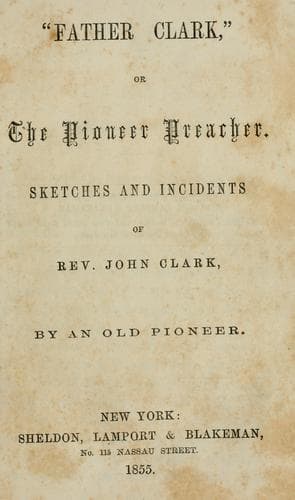
"Father Clark," or The Pioneer PreacherPeck, John Mason
History
"Father Clark," or The Pioneer Preacher
Peck, John Mason
Clark, John, 1758-1833; Methodist Episcopal Church -- Clergy
The rude cuts, or coarse illustrations, as they would now be called,
over the fables in the Spelling-Book, were examined and criticised,
and the stories read, until they were “gotten by heart.” There was the
boy that stole apples, then on the tree, and the farmer throwing tufts
of grass to bring him down, and threatening “to try what virtue there
was in stones.” Then came the country girl, with the pail of milk on
her head, calculating the value when exchanged for eggs, these hatched
into chickens, and the chickens sent to market at Christmas, and the
profits invested in a new silk gown, in which she would eclipse all
her female companions during the holidays. Inflated with vanity in her
brilliant prospects, she acted out her feelings with a toss of the
head, when down came her pail of milk, and with it all her imaginary
happiness. And then there was the cat covered with meal, in the bottom
of the meal-tub, while the young rats were about to enjoy themselves
around the heap, until warned by an old and experienced rat, who “did
not like that white heap yonder.” “The bear and the two friends,”
furnished another fruitful source of mental speculation to the pupils
of Mr. Clark in the recess of school; while the fable of the Farmer
and Lawyer, and the amazing difference betwixt “your bull and my ox,”
caused bursts of laughter.
Thus the school went on, and the influence of the master in controlling
the feelings, the minds and habits of the pupils in school, or even on
the road-side, or at home, was overwhelming. This was effected by an
unusual commixture of firmness and kindness, dignity and familiarity,
never known before in a Kentucky school.
It was some weeks after the new books were introduced, that Mr. Jesse
Bush came into the settlement from Old Virginia, to see the country and
make a visit to his brother, one of the patrons of the school. Thomas
and Susan Bush were two bright eyed pupils of Father Clark, and were
discovered one evening by their uncle as he walked along the lane that
led to the house, gathering strips of loose, dry bark from the fence
rails for “lightwood.” Such combustible articles in the fire-place
were an excellent substitute for candles and lamps in new and frontier
settlements. Uncle Jesse had taken quite a fancy to his nephew and
niece. They had left the old dominion with their parents several years
before this period, and had grown so much that their affectionate uncle
would not have known them, had he met them any where else than at their
parents’ on his arrival. Susan was now eleven and Thomas thirteen years
old, and delighted to play and romp with him, no less than he did with
them.
It was in the month of October--the days had perceptibly grown shorter
and the nights longer. A fire was pleasant and comfortable, and the
lightwood threw up a cheerful blaze, while the industrious scholars
were getting their lessons until interrupted by their uncle.
Public-domain text, read in full here on John Shaqi.
Reviews
Reviews
No reviews yet
Be the first to share your thoughts on this work.
Elsewhere in the archive
Join the Discussion
Join the discussion
Sign in to leave a comment or review.
Sign InorCreate an account