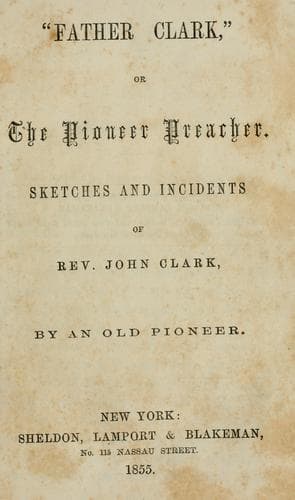
"Father Clark," or The Pioneer PreacherPeck, John Mason
History
"Father Clark," or The Pioneer Preacher
Peck, John Mason
Clark, John, 1758-1833; Methodist Episcopal Church -- Clergy
As the last quarter of the school drew towards the close, there was
evidently dissatisfaction and regret among the scholars. They had
learned the intentions of the master, and they trembled at the prospect
of losing a teacher who had treated them like reasonable creatures, and
who led them in such pleasant paths by the strong cords of affection
and respect. They really dreaded lest some illiterate whiskey drinking,
brutal Irishman, like master O’Cafferty with his shelalah, should
be engaged to tyrannize over them, and dry up every stream of true
happiness in the school. But their fears were imaginary. Every parent
and guardian would now have protested against such an imposition on
the community.
Before the close of the last term under master Clark, it was whispered
about that Joseph Helm would take charge of the school. Joseph was one
of Mr. Clark’s assistants, and showed much interest in the employment.
He was a stout Kentuckian, six feet in his shoes, with a commanding
appearance, and seriously disposed. The little ones had learned already
to call him master Helm; and on the whole he was worthy of the mantle
of master Clark.
The parting day came, and when about to dismiss the school for the last
time, the affectionate master was so overpowered by his feelings as
to be incapable of making his farewell address. He attempted to utter
a few words, but his voice choked, tears fell like heavy raindrops,
convulsive sobs heaved his breast, and he could only grasp their hands
with nervous energy, as they passed him towards the door-way.
And now another trial came on. The women in the settlement had provided
him with more articles of clothing than he could take with him, of
their own homely making. Every house in the settlement had been open
for him both as a visitor and a boarder, but the generous hearted men
were resolved he should not depart empty handed.
Bank bills at that period were wholly unknown in Kentucky, silver coin
was very scarce, and much of the business among the people was done
by barter. The proclamation had been made for the employers to meet
at the school house, and every one knew what was wanting. No one held
back, and two or three who could not attend the meeting sent their
perquisites by their neighbors. With no small sacrifice, about fifty
dollars were collected by a sort of average, according to the number
of scholars from each family, after excusing several families on
account of inability. A committee of three gentlemen was appointed to
wait on Mr. Clark, explain why no larger amount had been raised, and
present the acknowledgments of the whole settlement for his very useful
services, and their kind wishes for his welfare, and should he ever
return, how rejoiced would they be to receive him again.
Public-domain text, read in full here on John Shaqi.
Reviews
Reviews
No reviews yet
Be the first to share your thoughts on this work.
Elsewhere in the archive
Join the Discussion
Join the discussion
Sign in to leave a comment or review.
Sign InorCreate an account