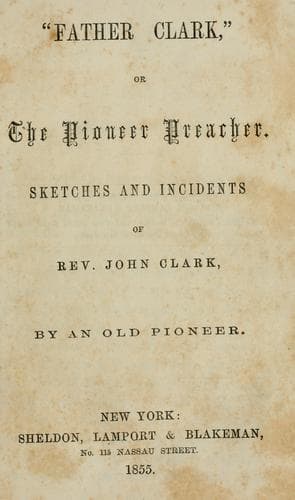
"Father Clark," or The Pioneer PreacherPeck, John Mason
History
"Father Clark," or The Pioneer Preacher
Peck, John Mason
Clark, John, 1758-1833; Methodist Episcopal Church -- Clergy
Mr. Clark had still a small sum left of his resources in Georgia,
including the gratuitous offerings on the way from that country, and
really _felt_ that he had no need of money. When he heard of the
meeting, he thought it had reference solely to the future school; but
what was his surprise, and even distress, when the committee called on
him that very evening, with their report, and the fifty dollars all
in silver coin! He desired to treat them courteously; he respected
and loved their hospitable and generous motives, but told them again
and again that the people owed him nothing--that all he asked when he
commenced the school was his board and clothing--that, in fact, he had
no use for the money, and finally, that he might be robbed and murdered
in the wilderness should he carry such an amount of wealth about him.
This last objection struck the committee as having at least some
practical sense in it, and after much parleying, he compromised the
matter by consenting with great reluctance to receive a small gratuity
as an expression of the friendship of the people.
“What a strange sort o’ man that Master Clark is,” said one
committee-man to the others, as they were returning homeward after
night-fall.
“Yes, he is sartin’ly mighty singular, not to take money for his labors
when he arn’d it, and ’tis offered him.”
“An’t he a leetle sort o’ crack’d?” asked another. “It looks like it,”
was the reply; “but, then a crack’d skull never could ’av’ managed the
youngsters as he did.”
“Well, I reckon he’ll suffer for that money yet, way in that Elenoy
country, ’fore he’d find a chance to get more. I b’lieve a man ought’r
get all the money he can honestly, ’specially when he’s arn’d it, as
Master Clark done.”
“I’m mind he’ll yet die a poor man, and it mought be he’d suffer a
heap ef he lives long in that new country, and gets no money to pay
’xpenses.”
“Well, I an’t sorry we raised it, no how; for he’d orter been paid; for
he’s done the childer a mighty heap of good.”
“And he’s a good man, that’s sartin’,” replied the first speaker; “and
ef John Clark don’t get to the ‘good country’ he talks of when he
preaches, I’m mighty fear’d nobody else will.”
And John Clark was not forgotten in Kentucky for many a year, nor his
singular ways, neither. There are a few old people still living, who
attended school under his instruction, who, as they express it, “never
seed the like on’t.” They do not believe, with all the “new fangled
ways,” and “heap o’ larnin,” and practical wisdom teachers now have,
that they can come up with preacher Clark.
CHAPTER X.
Public-domain text, read in full here on John Shaqi.
Reviews
Reviews
No reviews yet
Be the first to share your thoughts on this work.
Elsewhere in the archive
Join the Discussion
Join the discussion
Sign in to leave a comment or review.
Sign InorCreate an account