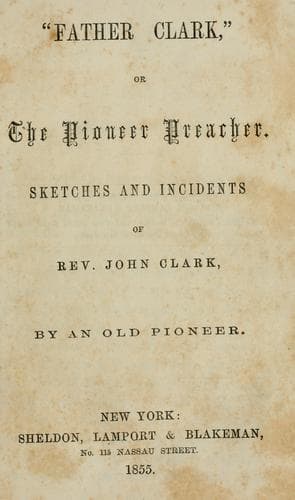
"Father Clark," or The Pioneer PreacherPeck, John Mason
History
"Father Clark," or The Pioneer Preacher
Peck, John Mason
Clark, John, 1758-1833; Methodist Episcopal Church -- Clergy
We now return to the father and son in Kentucky. They continued their
labor in the cornfield until dinner time, when the horse was ungeared,
and they returned to the house. There every thing was in confusion.
The feathers from the beds were scattered over the yard, the mother
and children were gone! The “signs” were too plain to leave any doubt
on the mind of the husband and father of their fate! They were Indian
captives, unless some were killed. The first natural impression was
that in attempting to flee they were butchered by these monsters of
the woods. Isaac began to cry and call loudly for his mother, until
he was peremptorily told by his father to hold his tongue and make no
noise, as some of the Indians might lie concealed, watching for him and
his son. He knew the character and habits of these cunning sons of the
forest, and stealthily examined in every direction for further signs.
He soon fell on their trail, as they left the clearing and entered the
woods, and saw in one or two places the tracks of his wife and little
ones. He now felt encouraged, for he knew that Indians more generally
kill persons on their first attack, and that when they take possession
of women and children they take them to their towns that they may adopt
them in the place of those they have lost, and train them up in Indian
ways, and thus increase the number and strength of the tribe. White
children who are trained by Indians make the smartest and often the
most ferocious savages.
The country where Mr. Gilham resided was very thinly settled, and it
was not until the next day he could raise a party strong enough to
pursue them with any prospect of success. He and his neighbors followed
the trail for some distance, but Indians when they expect pursuit are
very cunning and skillful in concealing their tracks, and turning their
pursuers in the wrong direction. When a large number are together, they
divide into small parties, and make as many separate trails as they
can. They will step with singular caution, so as to leave no marks,
and they will wander in opposite directions and make their trails
cross each other. When they come to a stream of water they will wade
a long distance in the water, and frequently in a contrary direction
to that of their journey, and unless their pursuers understand all
their tricks, they will not fail in deceiving them. Mr. Gilham and
his friends understood their strategy, but could not find their trail
after they once lost it. It is probable they struck the Ohio river some
distance from the crossing place of the Indians.
Public-domain text, read in full here on John Shaqi.
Reviews
Reviews
No reviews yet
Be the first to share your thoughts on this work.
Elsewhere in the archive
Join the Discussion
Join the discussion
Sign in to leave a comment or review.
Sign InorCreate an account