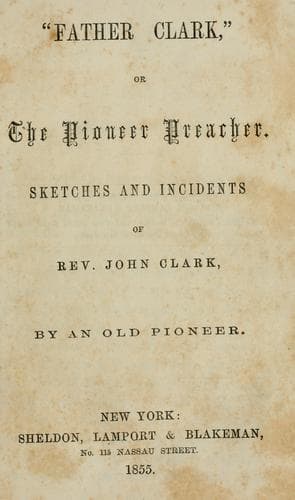
"Father Clark," or The Pioneer PreacherPeck, John Mason
History
"Father Clark," or The Pioneer Preacher
Peck, John Mason
Clark, John, 1758-1833; Methodist Episcopal Church -- Clergy
She was in great distress lest
her children should perish with hunger, or the Indians kill them. They
dared not hunt near the settlements, lest they should be discovered.
The coon was dressed by singeing off the hair over a blaze of fire,
and after throwing away the contents of the intestines, the animal was
chopped in pieces and boiled in a kettle with the head, bones, skin
and entrails, and made into a kind of soup. When done, and partially
cooled, the children, mother, and Indians sat around the kettle, and
with horn spoons, and sharpened sticks for forks, obtained a poor and
scanty relief from starvation.
They approached the Ohio river with caution, lest white people might
be passing in boats. They camped in the woods near the present site of
Hawesville, and made three rafts of dry logs, with slender poles lashed
across with thongs of elm bark, and placed them near the river, that
they might push them in and cross over before they became soaked in
water and heavy. The wily Indians were too cunning to cross by daylight
lest they should be discovered, and Mrs. Gilham was exceedingly
terrified at the danger of crossing by night. However they all got over
safely.
The warriors considered it a great achievement to capture a white
woman and three children in Kentucky, and elude all pursuit, and reach
their own villages on Salt Creek, in the Illinois country, without
being discovered. And they exercised all their cunning and sagacity to
accomplish this daring feat.
When they reached the wilderness south-west of the Ohio river, they
were in the Indian country, and proceeded slowly. They hunted with such
success in the country between the Ohio and White river that they had
plenty of provisions. They kept to the right of the white settlements
near Vincennes, and along the valley of White river, and crossed the
Wabash below Terre Haute, and proceeded through the present counties of
Clark, Coles and Macon to their towns in Logan county.[39]
There they held a season of feasting and frolicing with their friends
for their successful enterprize. And here we will leave Mrs. Gilham and
her children, distributed as they were among different Indian families,
and suffering all the hardships of Indian captives, until the war was
over in 1795.
Public-domain text, read in full here on John Shaqi.
Reviews
Reviews
No reviews yet
Be the first to share your thoughts on this work.
Elsewhere in the archive
Join the Discussion
Join the discussion
Sign in to leave a comment or review.
Sign InorCreate an account