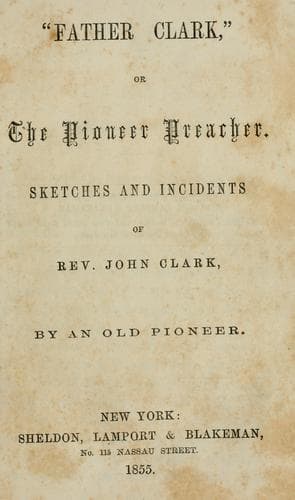
"Father Clark," or The Pioneer PreacherPeck, John Mason
History
"Father Clark," or The Pioneer Preacher
Peck, John Mason
Clark, John, 1758-1833; Methodist Episcopal Church -- Clergy
Early in the same season that Mr. Clark came with the Gilham family, a
colony of one hundred and twenty-six emigrants from the south branch
of the Potomac in Virginia, set out for Illinois. At Redstone, on the
Monongahela, (now Brownsville,) they fitted out several flat boats, on
which, with their horses and wagons, they floated down the current to
Pittsburgh, and thence down the Ohio to Massac, where they landed and
went across the country to the settlement of New Design. That season,
and especially after they left the Ohio, was unusually rainy and hot.
The streams overflowed their banks, and covered the alluvial, or bottom
lands on their borders; and the low ground in the woods and prairies
were covered with water. They were twenty-one days traveling through
this wilderness, the distance of about one hundred miles, and much of
it through dreary forests. The old settlers had been so long harassed
with Indian warfare, that farming business had been neglected, their
cattle were few in number, and bread corn was scarce. Their cabins
usually contained each a single room for all domestic purposes; and
though hospitality to strangers is a universal trait in frontier
character, it was entirely beyond the ability of the inhabitants
to provide accommodations for these ‘new comers,’ who arrived in a
deplorably famishing and sickly condition. They did all they could; a
single cabin frequently contained four or five families. Their rifles
could provide venison from the woods, but the weather that followed
the severe rains in midsummer was so unusually hot and sultry, that
their fresh meat spoiled before they could pack it from the hunting
grounds; and they were destitute of salt to preserve and season it.
Medical aid could be procured only from a great distance, and that very
seldom. Under such circumstances, no one need be surprised that of the
colony, who left Virginia in the Spring, only one-half of their number
were alive in autumn. A ridge in the western part of the settlement,
adjacent to the bluffs, was covered with the newly formed graves. They
were swept off by a putrid fever, unusually malignant, and which, in
some instances, did its work in a few hours. The old settlers were as
healthy as usual. No disease like this ever appeared in the country
before or since. Mr. Clark had good health, and found work enough among
these suffering families in nursing, instructing, and praying with
the sick, and consoling the dying. The settlement of New Design had
been commenced by American families about a dozen years previous. Its
situation was on the elevated plateau, about thirty miles north of the
town of Kaskaskia, and from ten to twelve miles from the Mississippi,
and from three to six miles east of the American bottom and contiguous
bluffs. Along the wide alluvial tract, or bottom, there were American
families settled at intervals from Prairie du Rocher to the vicinity
of Cahokia. The character of the American families was various. Some
Public-domain text, read in full here on John Shaqi.
Reviews
Reviews
No reviews yet
Be the first to share your thoughts on this work.
Elsewhere in the archive
Join the Discussion
Join the discussion
Sign in to leave a comment or review.
Sign InorCreate an account