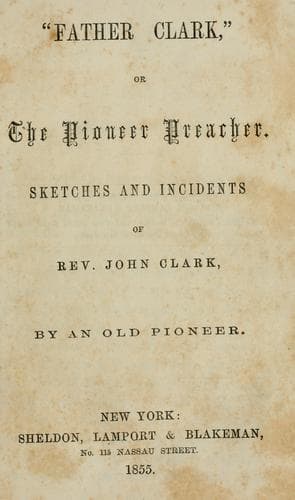
"Father Clark," or The Pioneer PreacherPeck, John Mason
History
"Father Clark," or The Pioneer Preacher
Peck, John Mason
Clark, John, 1758-1833; Methodist Episcopal Church -- Clergy
were religious people, both Baptists and Methodists; some were moral,
and respected the Sabbath; others were infidels, or at least skeptical
of all revealed truth. They paid no regard to religious meetings, and
permitted their children to grow up without any moral restraint. They
were fond of frolics, dances, horse-racing, card playing, and other
vices, in which they were joined by many of the French population from
the villages. They drank _tafia_,[41] and when fruit became plenty,
peach brandy was made, and rye whiskey obtained from the Monongahela
country.
There has been a very marked difference between these two classes of
pioneers, down to the third and fourth generation. But a very few of
the descendants of the immoral and irreligious class are to be found
amongst the present generation of the religious, moral, industrious
and enterprising class. They followed the footsteps of their fathers,
and have wasted away. Even the names of a number of these pioneer
families have been blotted out, while the children’s children, of the
virtuous class, are numerous and respected.
There were several families in the very commencement of these
settlements, before a preacher of the Gospel brought the glad tidings
here, or a single person had made a profession of religion, that held
meetings on the Sabbath, read portions of the Scriptures, or a sermon,
and sang hymns, and thus set a good example to the others. They and
their descendants have been favored of the Lord.
The first preacher who visited the Illinois country, was James Smith,
from Lincoln County, Ky. He was a “Separate Baptist,” and came on
business, in 1787, but preached to the people repeatedly, and many of
those who had kept up the meetings just noticed, professed conversion
under his preaching. Of these the Hon. Shadrach Bond, Captain Joseph
Ogle, James Lemen, Sen., his son-in-law, were conspicuous persons.
He made another visit to the country in 1790, after the Indians had
become troublesome, and preached with similar effect. While riding
to the meeting place, on a week day, in company with another man, and
a Mrs. Huff, they were fired at by a party of Kickapoos in ambuscade,
near the present site of Waterloo, in Monroe county. Mrs. Huff was
killed and scalped. The other man was wounded, but escaped with his
horse, and Mr. Smith taken prisoner. The Indians took him through the
prairies to their town on the Wabash, but he was afterwards ransomed
through the agency of a French trader. After the visits and preaching
of Mr. Smith, there were persons who could pray in these social
meetings, and when it was safe to live out of forts, they met at each
others houses, and Judge Bond, James Piggott, James Lemen, and some
others, conducted the worship.
Public-domain text, read in full here on John Shaqi.
Reviews
Reviews
No reviews yet
Be the first to share your thoughts on this work.
Elsewhere in the archive
Join the Discussion
Join the discussion
Sign in to leave a comment or review.
Sign InorCreate an account