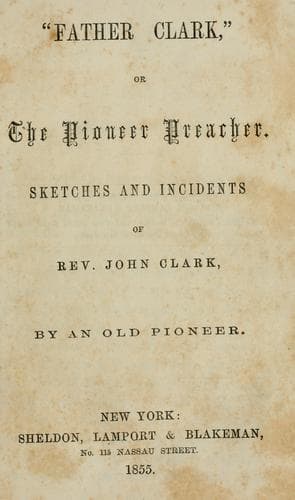
"Father Clark," or The Pioneer PreacherPeck, John Mason
History
"Father Clark," or The Pioneer Preacher
Peck, John Mason
Clark, John, 1758-1833; Methodist Episcopal Church -- Clergy
Savage Indians have astonishing propensities for war and plunder.
Before the European race came to this continent, the different nations
and tribes were fighting and plundering each other, and they still keep
up the practice, unless prevented by the strong arm of our national
government. Nothing short of the influence of the gospel on their
hearts can cure these diabolical passions.
The Indians who were hostile to the Americans did not attack the French
inhabitants, for they had been accustomed to trade with them, and had
been on friendly terms for half a century.
CHAPTER XI.
Religious families noticed.--Capt. Joseph Ogle.--James Lemen,
Sen.--The three associates.--Upper Louisiana.--Attack on
St. Louis.--The Governor a Traitor.--The assailants retire.
--American immigration encouraged.--Baptists and Methodists go
there.
With the religious families we have named, both Baptists and
Methodists, Mr. Clark found himself at home. All were hospitable,
kind and generous; no one begrudged him the comforts of life, in their
frontier mode of living. As he studiously avoided making any trouble,
and never appeared in the character of a preaching lounger, each family
made him welcome to their homely fare. As he was more frequently the
inmate of the families of Capt. Joseph Ogle, the Methodist class
leader, and James Lemen, a leading Baptist in the community, it will be
entertaining to our readers to have a sketch of these two pioneers.
CAPTAIN JOSEPH OGLE migrated with the Messrs. Zanes and other families,
from the south branch of the Potomac to the vicinity of Wheeling in
1769, where he distinguished himself in the siege of Fort Henry, in
1777. In the summer of 1785, he moved down the Ohio river to the
Illinois country, and at first settled in the American bottom, in the
present county of Monroe. Being well qualified, he was chosen for a
leader of the little band of pioneers, who had to defend themselves
from Indian assaults. Indeed he was just such a man as the people in
all exposed and frontier settlements look to as their counsellor, guide
and commander. He possessed uncommon firmness and self-possession,
had great energy, and yet was mild, peaceable, and kind-hearted in
social intercourse; always striving for the maintenance of peace, good
order and justice in the social relations. From the spring of 1784
to 1790, there was in fact no organized government in the Illinois
country. Some of the forms of law were kept up, but in a truthful sense
the people were “a law unto themselves,” and Captain Ogle, whom every
body respected, was exactly the kind of man to preserve order. Other
pioneers, who had talents and influence, occupied the same position.
And this too was the period of Indian alarms, and the people had to do
their own fighting. What the poet says of the fictitious Rolla, applied
with much pertinence to Captain Ogle--
“In war, a tiger chafed by the hunter’s spear;
In peace, more gentle than the unwean’d lamb.”
Public-domain text, read in full here on John Shaqi.
Reviews
Reviews
No reviews yet
Be the first to share your thoughts on this work.
Elsewhere in the archive
Join the Discussion
Join the discussion
Sign in to leave a comment or review.
Sign InorCreate an account