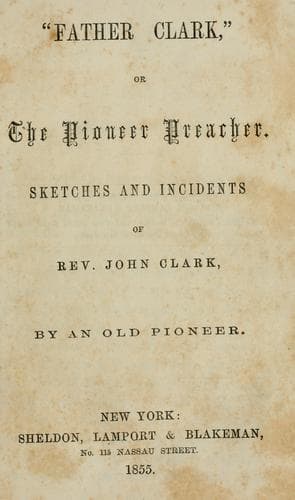
"Father Clark," or The Pioneer PreacherPeck, John Mason
History
"Father Clark," or The Pioneer Preacher
Peck, John Mason
Clark, John, 1758-1833; Methodist Episcopal Church -- Clergy
From 1786, to 1795, the American settlements in the Illinois country,
as was the case throughout the north-western territory, were harrassed
by hostile Indians. A part of the time the families were compelled to
live in forts, or as they were called, “stations.”
A square was marked out, in proportion to the number of families. On
two sides log cabins were erected in rows, with the roof sloping
to the inner side of the enclosure. Block houses were put up at the
corners, and so constructed that in the upper part which jutted over
the lower story, the guard could watch the approach of the enemy and
attack them successfully. The spaces not occupied by cabins were filled
up with palisades. Strong doors made of thick slabs, or split timbers
protected the places of ingress and egress. These stations were a
sufficient protection against the small marauding parties, that came
stealthily into the settlements. When no signs of hostile Indians were
seen for some months, the people, tired of living in these stations,
would remove to their cabins and attempt to raise a crop, when the
first alarm would be by some family being massacred, or individual
killed, in attempting to pass from one settlement to another. We could
give many thrilling instances of savage barbarity, but our space is
limited. They shall all be told, if we are successful in getting out
our projected series of PIONEER BOOKS.
While the women and children were compelled to stay in forts, the
men cultivated a field in common within sight of the station, and
one party with their trusty rifles scouted around as a guard, while
another party plowed and planted corn. No schools nor regular religious
meetings could be held during these Indian invasions.
When they ventured out of the forts, and resided on their farms, in
the absence of the men, pious mothers barricaded the door lest Indians
might come on them suddenly, and gathered the little children around
the huge fire place, for the light that shone down the large chimneys,
and taught them the rudiments of learning. No log cabin had any glass
windows, and if apertures were cut in the logs, it was not safe to
leave them open when Indians were about.
The Americans in these early settlements in Illinois did not trespass
on Indian rights, by taking their country. The Kaskaskia Indians
and their allies sold this part of the Illinois country, and gave
possession to the French nearly a century before the period of these
depredations, and the Kickapoos, Shawanoes and other Indians, whose
country was from one hundred and fifty to five hundred miles distant,
committed all the murders and robberies. The Kaskaskias remained
peaceable during the war, lived within the range of these settlements,
in the American bottom, a few miles above the town of Kaskaskia,
cultivated corn, beans, and other vegetables, and hunted in the
vicinity of the white settlements.
Public-domain text, read in full here on John Shaqi.
Reviews
Reviews
No reviews yet
Be the first to share your thoughts on this work.
Elsewhere in the archive
Join the Discussion
Join the discussion
Sign in to leave a comment or review.
Sign InorCreate an account