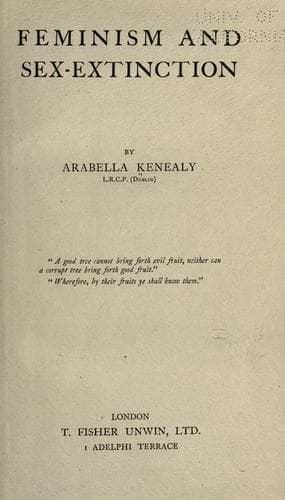
Feminism; Women; Women -- Social and moral questions; Women -- Social conditions
That both man and woman should be entitled to divorce for infidelity,
for incorrigible drunkenness, criminality or insanity on the part of the
mate, would be just and reasonable clauses in the marriage-code.
Because, apart from the unmerited cruelty and shame of such bondages, is
the risk of entailing degenerate offspring. Otherwise, it appears that
relaxation of the Divorce-Law would result in evils far worse than any
it would remedy. And these evils would re-act inevitably far more
cruelly--both temperamentally and materially--upon women and children
than upon men.
The conjugal and the paternal instincts being traits the sex has
acquired by long ages of developmental progress, for men to lose these
would be as easy as the loss would be degenerative to themselves and to
those others. Folly to suppose that having reached a certain stage of
human character-building, we can, with impunity, kick away the
foundations whereon our house of evolution has been raised; and on which
it must rest for all time.
The irrevocability of the marriage-contract is woman's greatest
security. Realisation of that sex-lawlessness which is an innate
Male-trait--relic of the promiscuous and cursory nature of the primal
male-instinct--should set us on guard against weakening, in the least
degree, this covenant, which is the best among those privileges whereby
man, in the teeth of his inherent instincts, has chivalrously protected
woman and the family. In the teeth of these, he has applied his natural
intelligent bent for Conformity in concrete affairs to the repression
and regulation of his impulses by the institution of Marriage. And
this--the apotheosis of masculine conformity to the exactions of
Progress--is now menaced by the native Non-conformity of woman,
exploited by Feminism.
It is notable that men are but seldom truly fond of, nor are they
faithful to the wife who works outside the home. In France, where the
clever, industrious wife of the middle and lower classes is more a
business-partner than she is a wife, conjugal fidelity is not expected.
Not only is a house without a woman in it to devote her best interests
and powers to the arts of home-making, not a home, but the bond of that
fraction of interest and affection left over to her from her work
outside it is a thing too slight to bind her husband to her. He finds no
difficulty in substituting--should he seek this--a haven with more
atmosphere of home and sentiment in it, companionship with more of
temperament in it, more resiliency and freshness, than that of the
industrious and wage-earning, but fatigued and jaded working-wife.
Public-domain text, read in full here on John Shaqi.
Reviews
Reviews
No reviews yet
Be the first to share your thoughts on this work.
Elsewhere in the archive
Join the Discussion
Join the discussion
Sign in to leave a comment or review.
Sign InorCreate an account