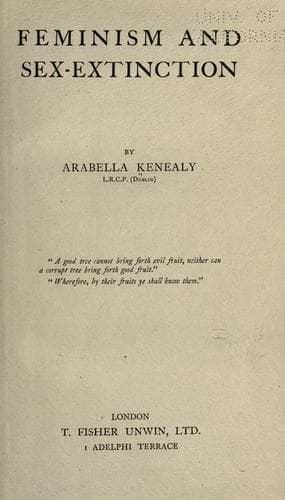
Feminism; Women; Women -- Social and moral questions; Women -- Social conditions
Moreover, if we are to make love the sole bond--clearly the waning of
love must release from the bondage. Further, when we sift out the purely
emotional element in the vast majority of unions, we shall find it but a
very slender factor among other more binding reciprocities. Certainly a
far more slender thread to trust to in the safeguarding of a contract
than is, for example, the factor of commercial honesty. Commercial
honesty is not, perhaps, a conspicuous virtue of the times.
Nevertheless, the sense of honesty in business is a good deal stronger
in most men than is their sense of honour with regard to love. And their
sense of honour in love has developed mainly as a direct consequence of
those legal compulsions and responsibilities of love which have been
exacted and fostered by the legality of marriage.
How many men are there, for example, who, having come to care for some
other, hold themselves bound in the least by an illicit tie; howsoever
much they may have cared at one time for the woman in the case? Lightly
come--lightly go! And if the terms, marriage and love, are by no means
necessarily synonymous, it has been, nevertheless, greatly by way of the
obstacles and compulsions and the social penalties attaching to
violation of the marriage vows that the love-passion has been purified
and uplifted out of the barbarism of mere instinct and promiscuity,
into the graces of emotion and the virtues of monogamy.
Had any man and woman, reciprocally attracted at their first meeting,
been free always to have carried this attraction straightway to its
biological conclusion, the sex-relation would be still the merely
physiological incident it was in primal forests. The circumstance that
such attraction has been debarred from ready consummation by the
obligations and the obstacles engendered by a recognised and legalised
bond between the sexes, has been debarred, moreover, in innumerable
cases, by one of the attracted couple being subject to this bond--all of
this has preserved the nascent emotion from straightway relapsing to the
basic level whence it sprang, and has fostered the evolution of love in
the higher reaches of emotion; of imagination, of controlled and
chastened passion.
It may be said that modern men and women, loving one another with the
more highly-evolved passion of our enlightened epoch, would love as
devotedly and would remain as constant in an illicit as in a legalised
union. If so, such constancy would be an echo mainly of the
long-dignified state of wedded constancy; and the greatest of all
tributes to the values of this. Nevertheless--For how long after the
clarion-note of aspiration sounded by Marriage should have ceased to
vibrate, would the echo of it last?
Public-domain text, read in full here on John Shaqi.
Reviews
Reviews
No reviews yet
Be the first to share your thoughts on this work.
Elsewhere in the archive
Join the Discussion
Join the discussion
Sign in to leave a comment or review.
Sign InorCreate an account