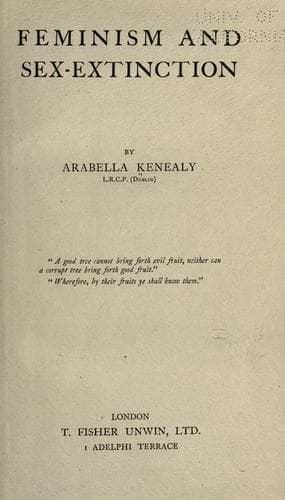
Feminism; Women; Women -- Social and moral questions; Women -- Social conditions
It stands for all that is best accomplished politically by his
highly-specialised order of brain; by his concrete energy and
initiative, his justice and rationalism, his power of administration,
and his uncompromising sternness--pitilessness, if need be--to deal with
and to punish crime and aggression, national and international. It
stands, in a word, for that virile outlook and the virile grip in
Statesmanship which are indispensable to materialise a people's
prosperity and to pioneer its progress. These are the functions of
_men_. Just as the Army and Navy, Science and Commerce, are the
functions of men. Because the male bent and intellect are those best
fitted to raise these developments to their highest and most effective
issues, just as the male physique and energy are best fitted to achieve
these issues in material results.
Had anything been needed to emphasise the values of such virile
characteristics in the administration of a nation's policy, the War
furnished it. And the many blunders and vacillations marring the conduct
of the War emphasised the lack of these invaluable masculine qualities
in the concurrent House of Commons. Army, Navy, and Air-Services proved
their manhood doughtily in their respective provinces. Had they been
supplemented by an equally virile Statesmanship, the War, having begun,
would have been brought to a speedy termination. In point of fact, it
would never have begun.
If now, our British politics are already so lacking in the manly ability
and grip indispensable to national permanence and progress, the presence
of women in Parliament can but further emasculate these. It may be said
that some women outside the House are more male of mind and mode (not to
speak of muscle) than are some men inside. But this is reason, surely,
for replacing these weak males by stronger ones, rather than for
adulterating British statesmanship with Femaleness.
The presence of a masculine woman in a house--whether this be writ with
a small or a capital letter--far from stiffening the manly calibre of
weak men in it, only further enervates and paralyses them. To serve on a
committee of mixed sex is to realise this.
Women should be represented in the counsels of the nation--but not in
the councils of men. They should have a House of their own, wherein to
foster the interests of women and children mainly, as well as to further
The Humanities and The Moralities; which are, at the same time, woman's
true political sphere and her chiefest concern--because she and the
child most suffer from failures thereof. Thus, the House of Men would be
relieved of problems their sex is unqualified to deal with. While more
time and energy would be left them to dispose of affairs they are best
fitted to administer.
Public-domain text, read in full here on John Shaqi.
Reviews
Reviews
No reviews yet
Be the first to share your thoughts on this work.
Elsewhere in the archive
Join the Discussion
Join the discussion
Sign in to leave a comment or review.
Sign InorCreate an account