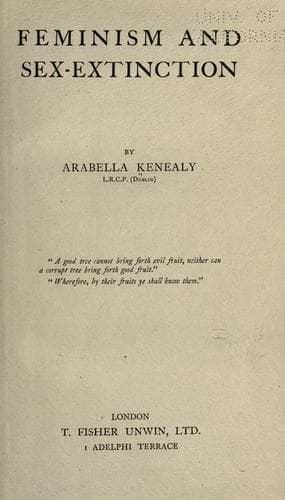
Feminism; Women; Women -- Social and moral questions; Women -- Social conditions
Threatening, as it does, a drastic sweep of all political, economic and
every other difference between the standards, training, and employment
of the sexes, it was pressed forward, nevertheless, not only with
characteristic masculine failure to recognise the vital significance of
the other sex in Human Things, but in utter blindness to social and
racial consequences, immediate and remote, which make it possibly the
most momentous decision ever arrived at in the history of human
progress.
Showing how little it was known for the turning-point in our great
destiny, the question was debated with unseemly levity, while less than
half the parliamentary members troubled (or had hardihood) to record
their votes; the abstention of the others proving which way blew the
straws of their faint wills. And of those voting in favour, half,
perhaps, did so (as some confessed) under intimidation of otherwise
losing their seats. (What would be said of the soldier who should turn
his back upon the enemy for fear of losing life even?)
No more than twenty-five found courage to say their "No's" like honest
gentleman.
Yet far from Enfranchisement having been a burning need blazing in the
hearts of women, their newly-awarded vote required to be spurred and
whipped out of all but a small minority. Or coaxed from them by
abandoning appeal on all the wider issues of Imperial and national
policy, and, in so far as their interest was sought, by reducing the
programme to personal and domestic issues--electric lighting in their
parlours, hot-water taps in their kitchens, and so forth.
And here was seen, at once, the threat of a grave and an increasing
diversion from that purely political outlook of men, which should be
impersonal in issue, broad in enterprise. Not that the human and
domestic side is a whit less momentous than the more abstract and
national. But appealing to a different order of mind, it demands that
different order of mind which characterises the woman-sex, to deal with
it effectively.
The plea that women will acquire in time the masculine political
view-point threatens, on the other hand, the loss in them of their own
highly-specialised and invaluable interests, morale and qualities;
which, being womanly of impulse and of trend, make for the individual
welfare, happiness and elevation of the nation's members.
III
As with every other human function, there are two departments of
politics. And the House of Commons represents man's.
Public-domain text, read in full here on John Shaqi.
Reviews
Reviews
No reviews yet
Be the first to share your thoughts on this work.
Elsewhere in the archive
Join the Discussion
Join the discussion
Sign in to leave a comment or review.
Sign InorCreate an account