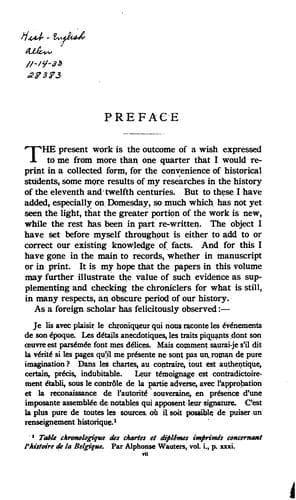
Feudal England: Historical Studies on the Eleventh and Twelfth CenturiesRound, John Horace
History
Feudal England: Historical Studies on the Eleventh and Twelfth Centuries
Round, John Horace
Domesday book; Feudalism -- Great Britain; Great Britain -- History -- Norman period, 1066-1154; Normans -- Great Britain
In Risun habuit Elnod iiii. Picotus filius Colsuaini habet
bovatas terre ad geldum ... Nunc dimidiam carrucatam in Rison,
habet Colsuan de abbate Turoldo quam abbas dedit patri suo tali
(i. 345_b_). servicio quod esset ad placita
abbatis et manuteneret res suas
et homines suos in scira et in
aliis locis (p. 175).
This second entry not only records a peculiarly interesting
enfeoffment, but identifies 'Colsuan', the Abbot's under-tenant
at Riseholme, with no less a person than the conqueror's 'English
favourite Coleswegen, ... an Englishman who, by whatever means,
contrived to hold up his head among the conquerors of England'.[3]
As sons, in such cases as these, have succeeded their fathers, it need
not surprise us that our list comprises some names that are found in
the _Liber Niger_ survey of 1125.[4] Vivian, whom, it tells us, Abbot
Turold had enfeoffed at Oundle (p. 175) occurs there in that survey
(p. 158), as does Robert d'Oilli at Cottingham (pp. 159-73).[5]
Vitalis ('Viel') Engaine had succeeded William (Engaine) at Pytchley
both in our list and in the survey of 1125 (cf. _ante_, p. 129).
One of the most interesting and important points in this list of
knights is the gleam of new light it throws on Hereward 'the Wake'. In
it we read:
Hugo de Euremou iii. hidas in dominio et vii. bovatas in
Lincolneshira, et servit pro ii. militibus.
Ansford iii. carucatas et servit pro dimidia hida [_sic_].
Now Hugh de Euremou is the name of the man who, according to the
pseudo-Ingulf, married Hereward's daughter. Here we have proof of his
real existence, and are enabled moreover to detect him, I claim,
in that Hugh who, as a 'miles' of the Abbot, held three hides at
'Edintone' [Etton, Northants] in Domesday (i. 222). Mr Freeman
speaking of the vacancy at Bayeux in 1908, wrote:
William at once bestowed the staff on Turold, the brother of
Hugh of Evermont [_sic_], seemingly the same Hugh who figures
in the legend of Hereward as his son-in-law and successor.[6]
But the French editors of Ordericus, in a note to the passage from
which this statement was taken (iv. 18), speak of our man as 'Hugue
d'Envermeu, donateur du prieuré de St. Laurent d'Envermeu à l'Abbaye
de Bec'.[7]
Turning for a moment from Hugh to Ansford, we read in the Lincolnshire
'Clamores':
Terram Asford in Bercham hund' dicit Wapentac non habuisse
Herewardum die quo aufugiit (D.B., i. 376_b_).
About this entry, as Mr Freeman observed, 'there can be no doubt'.
But as the result of his careful inquiry,[8] he limited 'our positive
knowledge', from Domesday, to this entry and to two in the text of the
Lincolnshire survey (364_b_-377). It is strange that he did not follow
up the clue the 'Clamores' gave him. The relevant entry in the text of
the Survey is duly found under the Peterborough fief:
Public-domain text, read in full here on John Shaqi.
Reviews
Reviews
No reviews yet
Be the first to share your thoughts on this work.
Elsewhere in the archive
Join the Discussion
Join the discussion
Sign in to leave a comment or review.
Sign InorCreate an account