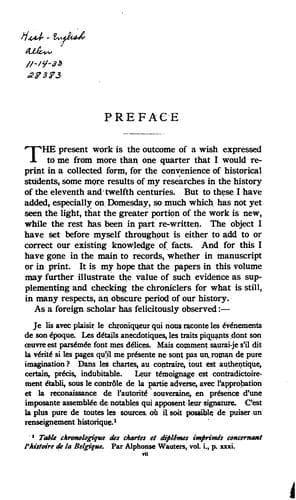
Feudal England: Historical Studies on the Eleventh and Twelfth CenturiesRound, John Horace
History
Feudal England: Historical Studies on the Eleventh and Twelfth Centuries
Round, John Horace
Domesday book; Feudalism -- Great Britain; Great Britain -- History -- Norman period, 1066-1154; Normans -- Great Britain
[Footnote 247: 'De his terris quas, ut diximus, suo tempore
acquisivit, quibusdam bonis hominibus pro magna necessitate et
honore ecclesiae dedit, et inde Deo et sibi fideliter quamdiu
vixit serviebant' (_Chronicon Evesh._, p. 96). His successor,
Walter (1077-86), incited by his own young relatives, 'noluit
homagium a pluribus bonis hominibus quos praedecessor suus
habuerat suscipere eo quod terras omnium, si posset, decrevit
auferre' (_ibid._, p. 98). In the result, 'dicitur quod fere
omnes milites hujus abbatiae haereditavit' (_ibid._, p. 91).]
[Footnote 248: He begged Anselm that 'terras ecclesiae
quas ipse rex, defuncto Lanfranco, suis dederat pro statuto
servicio, illis ipsis haereditario jure tenendas, causa sui
amoris, condonaret' (_Eadmer_).]
[Footnote 249: Foundation charter of Alcester Priory.]
[Footnote 250: Three other documents are found on the same
folio. Of these the first is addressed to Lanfranc, Odo of
Bayeux, Bishop Wulfstan, and Urse d'Abetot, and witnessed by
Bishop Geoffrey (of Coutances) and (like our writ) by Eudo
Dapifer, being also witnessed, like it, at Winchester. It is
noteworthy that it grants Æthelwig the Hundred of Fishborough
'in potestate et _justitia_ sua'.]
[Footnote 251: Cott. MS. Vesp. B. xxvi. f. 15[18].]
[Footnote 252: 'Rex commisit ei curam istarum partium terrae
... ita ut omnium hujus patriae consilia atque judicia fere in
eo penderent' (_Hist. Evesham_).]
[Footnote 253: Florence of Worcester.]
[Footnote 254: 'Cernens itaque rex grande sibi periculum
imminere, debitum servitium ... exigit' (_Liber Eliensis_, p.
276).]
[Footnote 255: 'Rex Henricus contra fratrem suum Robertum,
Normanniae comitem, super se in Anglia cum exercitu venientem,
totius regni sui expeditionem dirigit' (_Cart. Abingdon_, ii.
121).]
[Footnote 256: In the former case, between the crown and
its tenant; in the latter, between the tenant and his
under-tenant.]
[Footnote 257: 'Idem [Godcelinus de Riveria] dicebat se non
debere facere servitium, nisi duorum militum, pro feudo quem
tenebat de ecclesia, et abbas et sui dicebant eum debere
servitium trium militum' (_Cart. Abingdon_, ii. 129). 'Cum a
quodam duos milites ad servicium regis exigerem (tantum enim
inde deberi ab olim a commilitonibus didiceram) ipse toto
conatu obstitit, unius dumtaxat se militis servicio obnoxium
obtestans.'--Henry, Abbot of Glastonbury (_Domerham_, p.
318).]
[Footnote 258: Thus undermining Mr Freeman's argument: 'We
hear of nothing in Domesday which can be called knight-service
or military tenure in the later sense; the old obligations
would remain; the primeval duty of military service, due, not
to a lord as lord, but to the state and to the king as its
head, went on,' etc. (_Norm. Conq._, v. 371).]
[Footnote 259: _Norm. Conq._, v. 865.]
Public-domain text, read in full here on John Shaqi.
Reviews
Reviews
No reviews yet
Be the first to share your thoughts on this work.
Elsewhere in the archive
Join the Discussion
Join the discussion
Sign in to leave a comment or review.
Sign InorCreate an account