Feudal England: Historical Studies on the Eleventh and Twelfth CenturiesRound, John Horace
History
Feudal England: Historical Studies on the Eleventh and Twelfth Centuries
Round, John Horace
Domesday book; Feudalism -- Great Britain; Great Britain -- History -- Norman period, 1066-1154; Normans -- Great Britain
It is indispensable to a clear view of the constitutional law
and governmental institutions of this country, that we should
not lose sight of the distribution of landed estates among
the great families, and that the rise and fall of these houses
should be carefully traced and steadily borne in mind....
Amidst all the tumult and confusions of civil and foreign
wars; throughout religious and political revolutions; from the
days of Arminius to those of Harald; from the days of Harald
to our own; the successions of the landowners and the
relations arising out of these successions, are the running
comment upon the events in our national history: they are at
once the causes and the criteria of facts, and upon them has
depended the development and settlement of principles, in laws
which still survive, in institutions which we cling to with
reverence, in feelings which make up the complex of our
national character.[17]
The paper on 'Walter Tirel and his wife' may serve to show that in
this department there is still needed much labour before we can hope
for a perfect record of the great houses of the Conquest.
* * * * *
I have to thank Mr Murray for his kind permission to make use of two
of the articles I have contributed to the _Quarterly Review_. Some
of the studies have previously appeared in the _English Historical
Review_, and these are now republished with Messrs Longmans' consent.
Lastly, I would take the opportunity afforded by this preface of
acknowledging the encouragement my researches have derived from the
approval not only of our supreme authority--I mean the Bishop of
Oxford--but also of that eminent scholar, Dr Liebermann, whose name
one is proud to associate with a work on mediaeval history.
J. H. ROUND
[_Note_: I have not thought it needful to include in the index names
of persons or places only introduced incidentally in illustration of
arguments. The prefix 'Fitz', as in _Geoffrey de Mandeville_, has been
retained as a useful convention, whatever the actual name may have
been.]
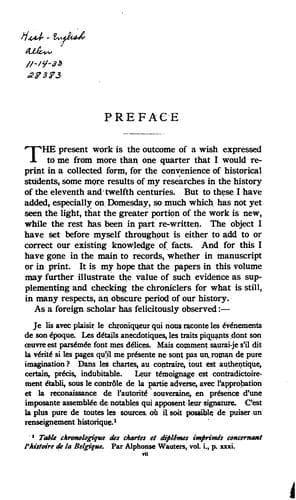
[Footnote 1: _Table chronologique des chartes et diplômes
imprimés concernant l'histoire de la Belgique._ Par Alphonse
Wauters, vol. i, p. xxxi.]
[Footnote 2: See pp. 198, 208, 404-5.]
[Footnote 3: See p. 430.]
[Footnote 4: Prof Maitland informs me that since the
appearance of his _Select Pleas in Manorial Courts_, he has
discovered the earlier occurrence of the word 'leet' (see p.
90).]
[Footnote 5: See _Domesday Studies_.]
[Footnote 6: _Fortnightly Review_, December 1894, pp. 804-5.]
[Footnote 7: _Quarterly Review_, July 1892.]
[Footnote 8: See _Quarterly Review_ as above. ]
[Footnote 9: See pp. 263-9.]
[Footnote 10: _English Historical Review_, July 1894.]
[Footnote 11: _Contemporary Review_, March 1893, pp. 335-55.]
[Footnote 12: _Norman Conquest_ (2nd Ed.), iii, 763-4.]
Public-domain text, read in full here on John Shaqi.
Reviews
Reviews
No reviews yet
Be the first to share your thoughts on this work.
Join the Discussion
Join the discussion
Sign in to leave a comment or review.
Sign InorCreate an account