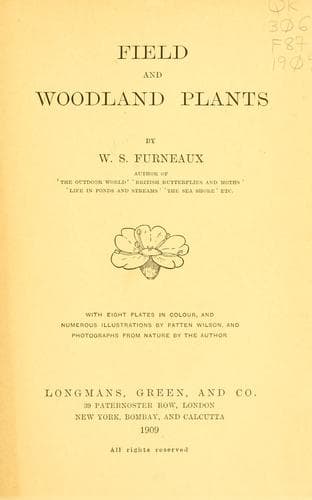
Plants -- Identification; Wild flowers -- Great Britain
1. Flowers not in catkins--Orders 68-71.
2. Flowers in catkins--Orders 72-76.
_Monocotyledons_
(Leaves usually with parallel veins. Parts of flower in
threes or multiples of three)
I. Perianth (see p. 11), coloured or petal-like, not scaly. (Sometimes
absent.)
A. Ovary inferior.
1. Leaves with parallel veins--Orders 77-80.
2. Leaves with netted veins--Order 81.
B. Ovary superior--Orders 82-88.
II. Flowers without perianth, enclosed in scales or husks.
A. Grassy herbs, with solid stems; leaves forming unsplit
sheaths round the stem; flowers in spikelets, with one
to three stamens--Order 89.
B. Grassy herbs, with hollow stems; leaves generally forming
split sheaths round the stem; flowers generally
perfect, with three stamens--Order 90.
SYNOPSIS OF THE NATURAL ORDERS
1. RANUNCULACEÆ.--Herbs mostly with alternate leaves and regular
flowers. Sepals generally 5, distinct. Petals 5 or more. Stamens 12 or
more. Pistil of many distinct carpels. Fruit of many one-seeded achenes.
(The Buttercup Family.)
2. BERBERIDACEÆ.--Shrub with compound spines; alternate, spiny leaves;
and pendulous flowers. Sepals 6. Petals 6. Stamens 6. Fruit a berry.
(The Berberry Family.)
3. NYMPHÆACEÆ.--Aquatic plants with floating leaves and solitary
flowers. Petals numerous, gradually passing into sepals outwards, and
into stamens inwards. Ovary of many cells, with many seeds. (The
Water-lily Family.)
4. PAPAVERACEÆ.--Herbs with a milky sap; alternate leaves without
stipules; and regular (generally nodding) flowers. Sepals 2, deciduous.
Fruit a capsule. Petals 4. Stamens many. Ovary one-celled, but with many
membranous, incomplete partitions. (The Poppy Family.)
5. FUMARIACEÆ.--Herbs with much divided, exstipulate leaves; and racemes
of small irregular, bracteate flowers. Sepals 2 or 0, deciduous. Petals
4, irregular. Stamens 6, in two bundles. Ovary of two carpels,
one-celled. (The Fumitory Family.)
6. CRUCIFERÆ.--Herbs with alternate, exstipulate leaves, and racemes of
regular flowers. Sepals 4. Petals 4, cruciform. Stamens 6, four longer
and two shorter. Ovary one-or two-celled. Fruit a siliqua. (The Cabbage
Family.)
7. RESEDACEÆ.--Herbs or shrubs with alternate, exstipulate leaves; and
spikes of irregular, greenish flowers. Sepals 4 or 5, persistent. Petals
4 to 7, irregular. Stamens many. Ovary of 3 lobes, one-celled. (The
Mignonette Family.)
8. CISTACEÆ.--Herbs or undershrubs with entire, opposite leaves; and
conspicuous, regular flowers. Sepals 3 to 5. Petals 5, twisted in the
bud. Stamens many. Ovary of 3 carpels, one-chambered. (The Rock-rose
Family.)
9. VIOLACEÆ.--Herbs with alternate, stipuled leaves; and axillary,
irregular flowers. Sepals 5, persistent. Petals 5, unequal, the lower
one prolonged into a spur. Stamens 5. Ovary of three carpels,
one-celled. (The Violet Family.)
Public-domain text, read in full here on John Shaqi.
Reviews
Reviews
No reviews yet
Be the first to share your thoughts on this work.
Join the Discussion
Join the discussion
Sign in to leave a comment or review.
Sign InorCreate an account