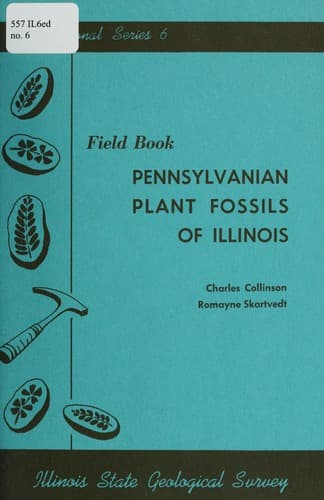
At the beginning of the Pennsylvanian Period, Illinois was part of a
vast lowland that stretched for hundreds of miles to the north, south,
and west, and was bordered on the east by highlands. At times much of
the plain was swampy and, because the climate was relatively warm and
moist, great jungles of fast growing trees, shrubs, and vines covered
the landscape. As successive generations of plants lived and died, plant
material fell into the swamp waters and, protected there from decay,
accumulated.
Frequently during the period, seas spread over the swampy lowlands,
submerging the forests and covering them with mud. Each submergence
lasted only a short time, geologically speaking. When the seas withdrew,
the deposits of sand and mud left behind were cut by streams that
carried fresh sand and mud from the eastern highlands. The streams
eventually became clogged with sediments and when the lowland was again
depressed swamp conditions returned and forests grew afresh. Such a
cycle of deposition was repeated again and again during Pennsylvanian
time, and after burial each layer of plant material gradually lost most
of its liquids and gases and was slowly converted into one of the
numerous coal beds presently found in Illinois.
[Illustration: Reconstruction of Pennsylvanian Coal-forming Swamp]
In some places in the state conditions existed that were especially
favorable for preservation of plants, and there delicately preserved
fossils are found in great numbers. In the most favorable areas, such as
in northern Illinois, the plants are preserved in stony nodules called
concretions, but they also may be found separately as molds, casts, or
petrifactions.
Molds (concave surfaces) and casts (convex surfaces) are fossilization
phenomena in which the actual plant, embedded in the surrounding
background rock, was dissolved, leaving a hollow space (mold) that
subsequently filled with other material. A cast was thus formed that
preserved the plant’s external features.
Most petrifactions are fossils in which silica, carbonate, or other
material permeated or replaced the internal structures of the plant and
preserved them so well that in most specimens the finest cellular
details can be observed. Compressions, another kind of petrifaction, are
the pressed carbonized remains of the plant itself.
PENNSYLVANIAN FLORA
[Illustration: _Aphthoroblattina_]
[Illustration: _Teneopteron_]
Public-domain text, read in full here on John Shaqi.
Reviews
Reviews
No reviews yet
Be the first to share your thoughts on this work.
Join the Discussion
Join the discussion
Sign in to leave a comment or review.
Sign InorCreate an account