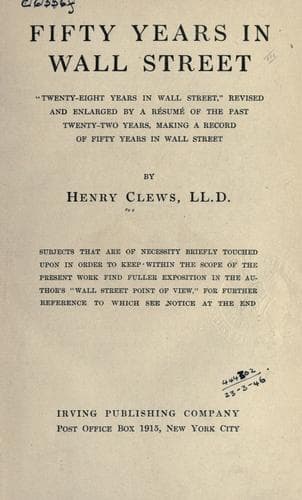
Business; Capitalists and financiers -- United States; Speculation; Wall Street (New York, N.Y.)
The members of the Legislature employed to pass the bill pocketed the
money of the Commodore and then hatched a conspiracy, after the manner
of the Common Council, to ruin him and make millions by his fall. He had
a shrewd lobbyist in the Legislature, however, who attentively watched
his interests while he came down to New York to purchase stock for the
rise that must have necessarily followed the passage of the bill. He had
not been long in Wall Street when he was informed that the Legislature
were imitating the game in which the Common Council had been so signally
defeated the previous year. The Commodore sent him word to keep close
watch at Albany, and he went on buying stock in Wall Street.
The bill was defeated. Harlem stock had a slump from 150 to 90. The
Commodore was in a dilemma, and would have been dreadfully embarrassed
only for the intense avarice of the Legislature. If they had bought and
delivered at 90, they would have made millions, which the Commodore
would have lost; but, like the horse leech’s daughter, they cried out
for more. Nothing would satisfy them until the stock should be depressed
to 50. Then they could “scoop” in several millions and the Commodore
would be wound up. This was probably the darkest hour in the Commodore’s
life. He hardly knew which way to turn. He was on the ragged edge. He
has often pathetically described his feelings at this crisis to his
intimate friends. He was almost on the brink of despair. He sent for old
John Tobin, who had been a gate keeper at the ferry-house at Staten
Island. Tobin had made quite a haul in the former deal in Harlem, and
was worth over a million. He told Tobin what the perfidious members of
the Legislature had done. John had been buying Harlem also in prospect
of a rise.
“They stuck you too, John,” said the Commodore. “How do you feel about
it?” John sighed, and replied that his feelings were not the most
enviable. “Shall we let ’em bleed us?” queried the Commodore.
John sighed again, but did not know what reply to make.
“John, don’t them fellows need dressing down?” emphatically queried the
Commodore. John answered in the affirmative, but did not see how it was
to be accomplished, as “them fellows” at that moment seemed to hold the
fort.
After a pause of deep reflection, the Commodore, again addressing John
with intensified emphasis in his tone, said: “John, let us teach ’em
never to go back on their word again as long as they draw breath. Let us
try the Harlem ‘corner’ once more.”
It was agreed to try and repeat the Harlem “corner.”
John put up a million. Leonard Jerome also went into the deal. It took
five millions to face the Legislature in this game, in which they had
every opportunity of packing all the cards. It was virtually, at first,
a silent game of whist, at which the Commodore was a noted player. He
never played with greater skill than this time, except in the Hudson
“corner,” and in both instances he almost manifested the skill of
inspiration.
Public-domain text, read in full here on John Shaqi.
Reviews
Reviews
No reviews yet
Be the first to share your thoughts on this work.
Elsewhere in the archive
Join the Discussion
Join the discussion
Sign in to leave a comment or review.
Sign InorCreate an account