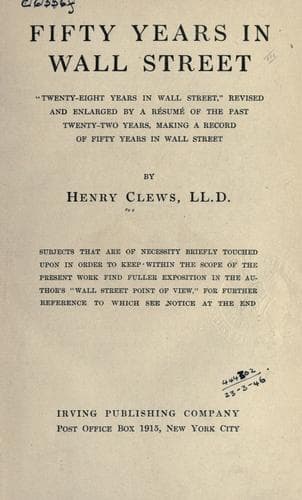
Business; Capitalists and financiers -- United States; Speculation; Wall Street (New York, N.Y.)
The Common Council were not immaculate in those days either, though the
Jaehnes and Waites escaped punishment. They basely deceived the
Commodore after taking his money; but he punished them severely. As soon
as the franchise was granted, Harlem advanced to 75, and the Aldermen
began to sell it “short.” They thought they had the Commodore fast in
their clutches, and took their friends into the secret. They expected to
sell enough of stock to make several millions. Their plan was to sell
“short” all that the market would take, and then repeal the ordinance,
which would cause the stock to drop probably below 50. Drew was one of
the great bears in this deal with the Aldermen.
The Commodore got wind of the scheme, went on buying, and got others to
help him, taking all the “shorts” that were offered. The operators had
soon sold a great deal more Harlem stock than there was actually in
existence. There were 110,000 shares of Harlem. When the Aldermen and
their friends thought they had made millions, they repealed the
ordinance, and Judge Brady, in the Court of Common Pleas, at the same
time issued an injunction prohibiting the laying of rails on the
Broadway road.
Everybody thought that the Commodore was hopelessly ruined. Harlem
stock, however, dropped three points only, to 72. This created surprise
among the Aldermen and the bears. They thought it should have dropped to
50. The “shorts” went into the market for the purpose of covering.
Harlem ascended with amazing rapidity to 100, to 150, to 170 and finally
to 179. The Common Council were obliged to make their final settlements
at the last figure. The Commodore had all the stock. The Common Council
lost a million, and their friends, whom they had advised to sell
“short,” lost several millions. The Commodore “raked in” five or six
millions, and went on his way rejoicing and improving Harlem, having now
taken “Bill” in with him as vice president.
One would naturally imagine that the severe lesson which the Common
Council had received in “corners” would have taught others to beware of
the Commodore in this line of speculation, although it was new to him,
but it did not. People as a rule will not learn either by precept or
example. They must go through the rough experience themselves.
The Legislature soon fell into the same trap in which the Common Council
had been caught and which they had actually set for themselves. The
following year the Commodore secured control of the Hudson River
Railroad through the purchase of its stock, and afterwards secured a
sufficient number of the members of the Legislature to pass a bill
consolidating the road with Harlem. He also won the promise of the
Governor to sign the bill.
Harlem again began to rise, and went from 75 to 150. This was early in
1864.
Public-domain text, read in full here on John Shaqi.
Reviews
Reviews
No reviews yet
Be the first to share your thoughts on this work.
Elsewhere in the archive
Join the Discussion
Join the discussion
Sign in to leave a comment or review.
Sign InorCreate an account