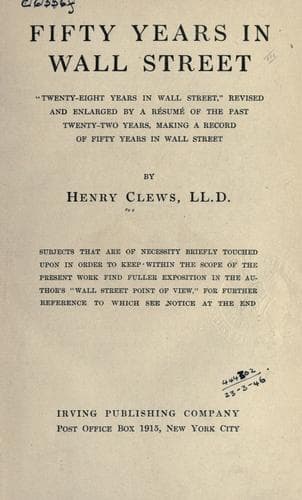
Business; Capitalists and financiers -- United States; Speculation; Wall Street (New York, N.Y.)
DREW, LIKE VANDERBILT, AN EXAMPLE OF GREAT SUCCESS WITHOUT
EDUCATION.—CONTROLLED MORE READY CASH THAN ANY MAN IN AMERICA.—DREW
GOES DOWN AS GOULD RISES.-“HIS TOUCH IS DEATH.”—PREDICTION OF DREW’S
FALL.—HIS THIRTEEN MILLIONS VANISH.—HOW HE CAUGHT THE OPERATORS IN
“OSHKOSH” BY THE HANDKERCHIEF TRICK.—THE BEGINNING OF “UNCLE
DANIEL’S” TROUBLES.—THE CONVERTIBLE BOND TRICK.—THE “CORNER” OF
1866.—MILLIONS LOST AND WON IN A DAY.—INTERESTING ANECDOTE OF THE
YOUTH WHO SPECULATED OUTSIDE THE POOL, AND WAS FED BY DREW’S
BROKERS.
One of the most singular and eventful careers in Wall Street was that of
Daniel Drew, familiarly called “Uncle Daniel.” This man affords another
remarkable instance of the possibility of attaining great success by
stubbornly following up one idea, and one line of thought and purpose.
His life also shows that education is not necessary to success in the
acquisition of money, but, as I have attempted to show in another
chapter, may be a great hindrance.
This fact is abundantly illustrated in the lives of both Drew and
Vanderbilt. In fact, everybody who knew these two men were of the
opinion that with a fair or liberal education they would never have cut
a prominent figure as financiers. It is also questionable whether either
of them, with all their ability in other respects, would have been
capable, with their peculiar predilections for other pursuits, of
receiving a common school or college education. They, probably, had not
the capacity for that kind of acquisition. Perhaps it might have been
impossible for any teacher to make Drew pronounce the word shares
otherwise than “sheers,” or convince Vanderbilt that the part of a
locomotive in which, the steam is generated should not be spelt
phonetically, “boylar.”
It is more than probable that professors in grammar would have found it
a hopeless task to convince the Commodore that there was anything wrong
in the expression, “Never tell nobody what yer goin’ to do, till you do
it,” or Drew that it was improper to say to his broker, “Gimme them
sheers,” when he desired his stocks reduced to possession. Both men
seemed to think with the character in Shakespeare, that reading and
writing, like their other attributes, came by nature. They evidently
thought that their abilities for financiering emanated solely from that
source, and results largely bore them out in that interpretation. Both
had supreme contempt for persons of less ability than themselves in the
speculative arena, yet they were terribly jealous of rivals who essayed
to compete with them in their own peculiar methods of making money.
Cunning and shrewdness were the leading characteristics of Drew. Though
illiterate himself, he, however, showed that he appreciated education in
others, by erecting and endowing a seminary in his native place.
Public-domain text, read in full here on John Shaqi.
Reviews
Reviews
No reviews yet
Be the first to share your thoughts on this work.
Elsewhere in the archive
Join the Discussion
Join the discussion
Sign in to leave a comment or review.
Sign InorCreate an account