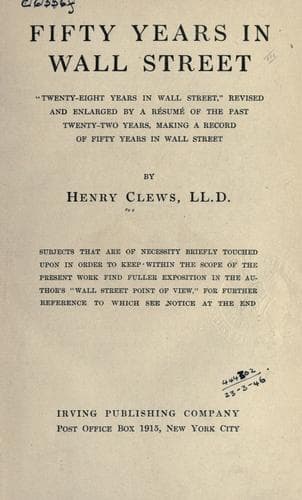
Business; Capitalists and financiers -- United States; Speculation; Wall Street (New York, N.Y.)
Some people who were not inclined to give Drew any credit for the finer
and more generous and genial feelings of man’s nature, said that his
motive for this endowment was merely popularity, and a morbid desire,
like that of Vanderbilt, to perpetuate his name.
Another motive, however, less ennobling to man’s nature, seemed to be
the true one. He saw that the religious element in society was then
influential, and that many religious people of his acquaintance were in
good circumstances, and he sought to ingratiate himself with them in
order to make use of them in his speculations.
This appears clearly to have been at the bottom of his precious gift of
a seminary to his native county. It was a curious illustration of
retributive justice, if I am right about his motive, that he was obliged
to default in the payment of that gift, with the exception of the
interest.
Daniel Drew, at one time, could command more ready cash at short notice
than any man in Wall Street, or probably than any man in America. His
wealth was estimated at thirteen million dollars. He made a very large
part of this out of his speculations in Erie stock, of which corporation
he was then managing director and treasurer. Being thus on the inside,
he was enabled to leave everybody else on the outside in the ups and
downs of the market, which he himself generally engineered.
The Street was frequently amazed by fluctuations of 20 or 30 per cent.
in Erie stock, sometimes in the course of a day or two, through the able
manipulation of Mr. Drew.
It was a sorry day for Drew when Jay Gould took his place in the control
of Erie, and it was equally disastrous for the Erie property.
From this period Gould began to grow rapidly to the full stature of
speculative manhood, while Drew moved as quickly in a downward
direction, until he found himself again at the lowest rung of the
financial ladder. It was no wonder that he said of Gould, “his touch is
death.”
Drew’s losses followed one another in quick succession, until his
thirteen millions had melted away like snow off a ditch, and eventually
he died in debt and broken hearted. His last days stand out as a sad,
but eloquent warning to the avaricious. And this reminds me of a festive
event, the chief incidents of which, I think, are worthy of
reproduction.
I remember being at a dinner party ostensibly given to the old gentleman
when in the very zenith of his financial fame and prosperity. It was a
kind of mutual admiration society, Drew being the king-pin of the social
coterie. On account of his thirteen millions he was the centre of
cringing admiration, and was by a number of the assemblage almost
deified.
As is usual on such occasions, speechmaking was in order, the oratorical
talent being called out by the toasts as they went the round of the
board.
When it came my turn to speak, I followed suit, to some extent, in
picking up the thread of the general glorification extended to the
honored guest, to whom I paid marked deference.
Public-domain text, read in full here on John Shaqi.
Reviews
Reviews
No reviews yet
Be the first to share your thoughts on this work.
Elsewhere in the archive
Join the Discussion
Join the discussion
Sign in to leave a comment or review.
Sign InorCreate an account