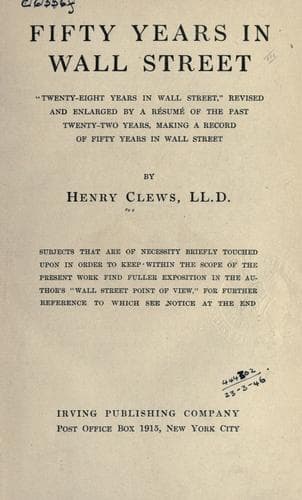
Business; Capitalists and financiers -- United States; Speculation; Wall Street (New York, N.Y.)
VANDERBILT ESSAYS TO SWALLOW ERIE, AND HAS A NARROW ESCAPE
FROM CHOKING.—HE TRIES TO MAKE DREW COMMIT FINANCIAL
SUICIDE.—MANIPULATING THE STOCK MARKET AND THE LAW COURTS AT THE
SAME TIME.—ATTEMPTS TO “TIE UP” THE HANDS OF DREW.—MANUFACTURING
BONDS WITH THE ERIE PAPER MILL AND PRINTING PRESS.—FISK STEALS THE
BOOKS AND EVADES THE INJUNCTION.—DREW THROWS FIFTY THOUSAND SHARES
ON THE MARKET AND DEFEATS THE COMMODORE.—THE “CORNER” IS BROKEN AND
BECOMES A BOOMERANG.—VANDERBILT’S FURY KNOWS NO BOUNDS.—IN HIS RAGE
HE APPLIES TO THE COURTS.—THE CLIQUE’S INGLORIOUS FLIGHT TO JERSEY
CITY.—DREW CROSSES THE FERRY WITH SEVEN MILLIONS OF VANDERBILT’S
MONEY.—THE COMMODORE’S ATTEMPT TO REACH THE REFUGEES.—A DETECTIVE
BRIBES A WAITER AT TAYLOR’S HOTEL, WHO DELIVERS THE COMMODORE’S
LETTER, WHICH BRINGS DREW TO TERMS.—SENATOR MATTOON GETS “BOODLE”
FROM BOTH PARTIES.
One of the most interesting episodes connected with the speculative life
of Drew, in the somewhat sensational history of Erie affairs, was the
interposition of Commodore Vanderbilt in one of the famous deals of the
Erie clique. His object was to swallow up the corporation, and it came
pretty near swallowing him. He was only saved by the skin of the teeth,
after one of the most prolonged and desperate financial struggles of his
life.
In order to explain clearly the manner in which the Commodore became
involved in the Erie matter with Drew and his partners, it will be
necessary to take a brief resume of the history of a few of his other
prominent deals, more fully dwelt upon elsewhere.
In 1860 Harlem stock had sold as low as eight or nine dollars a share.
In January, 1863, when Vanderbilt got full control of the property, the
stock had advanced to 30, and in July of the same year it had bounded to
92. In August, when the “corner” was effected, it went to the remarkable
figure of 179.
It was put through a similar operation the succeeding year, and the
stock, which sold in January below 90, was settled for in the following
June at 285. Drew had been drawn into one of these transactions, and his
losses reached nearly a million.
Vanderbilt’s prospects with the Harlem property were seriously menaced
by the competition of the Hudson River railroad. He bought up the
competing line, and thus destroyed the competition. He made this
purchase when the stock was at par. He soon manifested his superior
power in management, and displayed his skill in the art of “watering,”
which he had invented. He had the stock advanced to 180 in a very short
time.
Public-domain text, read in full here on John Shaqi.
Reviews
Reviews
No reviews yet
Be the first to share your thoughts on this work.
Elsewhere in the archive
Join the Discussion
Join the discussion
Sign in to leave a comment or review.
Sign InorCreate an account