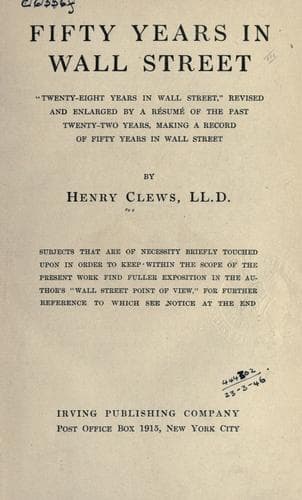
Business; Capitalists and financiers -- United States; Speculation; Wall Street (New York, N.Y.)
Seeing his great success with these two properties, through his novel
and unique methods of financiering, the managers of the New York
Central, thinking that discretion was the better part of valor, and
perceiving that they could not hold out against the edicts of manifest
destiny very long, offered their property to him almost at his own
price, which he very cordially accepted, approving their good judgment
and keen perception.
He obtained full control of New York Central early in 1867. As soon as
this triple amalgamation was complete he set his insatiable and
avaricious heart upon Erie, and essayed to compass his designs and
effect his purpose of reducing it to possession through the speculative
machinery of Wall Street.
It was through this channel that he had obtained Hudson, and in defiance
of the scientific maxim that lightning never strikes twice in the same
place, he was inspired with full confidence in his ability to “scoop”
Erie in the same manner. He tried first to arbitrate and consolidate,
but his efforts in that direction failed.
With all his marvellous foresight and almost unerring judgment in
speculative affairs, the Commodore was greatly at fault in his
calculation regarding the magnitude of the task he had now undertaken in
Erie. He had no idea of the immense volume of the stock which, after the
speculative battle began to rage, seemed to spring out of the ground,
spontaneously, as the reserve troops of Wellington were said to appear
to do in the eyes of Napoleon when the struggle waxed warm at Waterloo.
He had to contend with the ablest generals in speculation and finance
that ever Wall Street had produced. His first bold, flank movement was
an attempt to “corner” Drew. He knew how to manipulate the courts almost
as well as the Erie Ring did. Accordingly, he made use of the services
of Frank Work to obtain an injunction from Judge Barnard, of Tweed Ring
notoriety, restraining Drew from the payment of interest on 3½ million
bonds, pending an investigation of his accounts as treasurer of Erie.
This was followed up in a few days by another application to the court
for the treasurer’s removal from office.
These measures were resorted to by Vanderbilt to prevent the issue of
this stock, into which these 3½ million bonds were convertible, and thus
enable him to get a “corner” in the stock with greater facility. He thus
attempted to make the court instrumental in forcing Drew into a position
where he would be obliged to commit financial suicide.
The Erie Ring had managed to get legally around what in reality was an
over-issue of Erie stock and bonds in the following subtle manner:
Public-domain text, read in full here on John Shaqi.
Reviews
Reviews
No reviews yet
Be the first to share your thoughts on this work.
Elsewhere in the archive
Join the Discussion
Join the discussion
Sign in to leave a comment or review.
Sign InorCreate an account