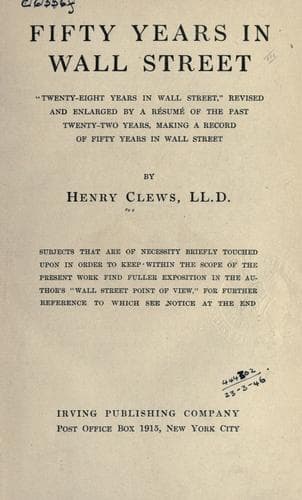
Business; Capitalists and financiers -- United States; Speculation; Wall Street (New York, N.Y.)
There was a statute of New York which authorized any railroad to create
and issue its own stock in exchange for the stock of any other road
under lease to it. The Ring had obtained the Buffalo, Bradford &
Pittsburg road, which was comparatively worthless, for carrying out this
scheme. The Erie management then set about supplying themselves with the
amount of Erie stock required, by leasing their own road to the road of
which they were directors. They then created stock and issued it to
themselves in exchange under the authority vested in them by law.
The nominal price of the road with which they worked this game of
legerdemain was $250,000. They issued bonds in its name for two millions
of dollars, payable to one of themselves as trustee.
Vanderbilt, before he could get a “corner” in Erie, had to place a limit
to the issue of the stock. Otherwise he would have been throwing away
millions, like pouring water into a sieve, in his attempt to make a
“corner.”
Drew was enjoined by the Commodore to return to the Treasury 68,000
shares of the capital stock of Erie. This was the amount that was said
to remain in the unsettled transactions of the Erie corner of 1866. This
was the sword of Damocles which Vanderbilt had suspended over Drew’s
devoted head.
Vanderbilt thus undertook to play the double game of manipulating the
courts and the stock market at the same time, and against wily
opponents, who were experts in both operations.
There were at this time three competitors for the possession of Erie in
the field. The Drew party, the Vanderbilt party, and the Boston,
Hartford and Erie party. Drew had tried to appease Vanderbilt to some
extent, and had an interview with him at Vanderbilt’s own house prior to
the election of the Erie directors. He agreed to “let up” on Vanderbilt,
and offered him greater swing in purchasing Erie, while, on the other
hand, Vanderbilt consented not to press the proceedings in court against
Drew.
Before this, the Boston party and Vanderbilt had been fixing matters to
oust Drew from the Erie directory. Now, Vanderbilt changed his tactics,
and resolved to let Drew remain. The Boston party was with him, but to
keep up the appearance of what had been formerly determined, the new
board was to be elected ostensibly without Drew, and a vacancy created
afterwards by which he could be chosen in the board. This method of
whipping the Devil around the stump was adopted to put public opinion
off its guard, and help to forward Vanderbilt’s purposes of
consolidation. The election scheme was successfully effected, but the
ruse, though well conceived, fell far short of accomplishing its
designs.
Public-domain text, read in full here on John Shaqi.
Reviews
Reviews
No reviews yet
Be the first to share your thoughts on this work.
Elsewhere in the archive
Join the Discussion
Join the discussion
Sign in to leave a comment or review.
Sign InorCreate an account