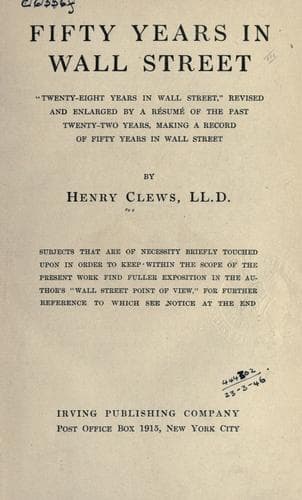
Business; Capitalists and financiers -- United States; Speculation; Wall Street (New York, N.Y.)
Notwithstanding our immense population and the large measure of
well-ordered consolidation that has been effected in our various
interests, we are still a nation of pioneers. In every ten years, we now
add nearly fifteen millions to our population, which means that each
successive decade we are piling up the equivalent of a first-class
European state upon our past marvellous accumulation of empire.
Inseparable from this unparalleled national growth are great ventures
and great commercial and financial risks. Our new population has to
subdue new territory. New lands have to be cleared; new mines have to be
opened; new industries have to be established; new railroads have to be
built; new banks created and new corporations founded. These new
ventures are necessarily in a measure experimental. Some of them fail
utterly; others succeed magnificently. They require large outlays of
capital in advance of obtainable results. These outlays are, in many
cases, met by borrowing; the loans being secured by liens upon the
uncertain undertakings, and therefore lacking the stability of value
that attaches to well developed investments.
We have thus a ceaseless stream of new issues of stocks, mortgages and
commercial paper, and have, therefore, at all times outstanding a large
amount of obligations which, from the uncertainty of their basis, are
liable to wide fluctuations in value. Besides these absolutely new
investments, we have also at all times an equal or larger amount of
obligations issued against enterprises which, although not properly new,
are still in an unconsolidated and experimental stage, and the value of
which is, therefore, subject to wide fluctuations. Issues of this
character naturally appeal to the adventurous instincts of our people
and elicit a vast extent of speculative activity.
It is this peculiarity in the development and trade of the United States
that renders our markets more exposed to panic than those of any other
nation, and which makes the question of panics a peculiarly American
one. In any and every commercial nation, trade is subject to regular
successions of prosperity and depression. This oscillation results from,
or constitutes a natural law.
Public-domain text, read in full here on John Shaqi.
Reviews
Reviews
No reviews yet
Be the first to share your thoughts on this work.
Elsewhere in the archive
Join the Discussion
Join the discussion
Sign in to leave a comment or review.
Sign InorCreate an account