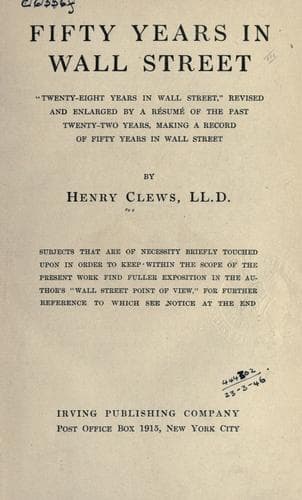
Business; Capitalists and financiers -- United States; Speculation; Wall Street (New York, N.Y.)
The action of commerce, like the motion of the sea or the atmosphere,
follows an undulatory line. First comes an ascending wave of activity
and rising prices; next, when prices have risen to a point that checks
demand, comes a period of hesitation and caution; then, care among
lenders and discounters; then comes the descending movement, in which
holders simultaneously endeavor to realize, thereby accelerating a
general fall in prices. Credit then becomes more sensitive and is
contracted; transactions are diminished; losses are incurred through the
depreciation of property, and finally the ordeal becomes so severe to
the debtor class that forcible liquidation has to be adopted, and
insolvent firms and institutions must be wound up. This process is a
periodical experience in every country; and the extent of the
destructiveness of the crisis that attends it depends chiefly on the
steadiness and conservatism of the business methods in each particular
community affected. In addition to this ordinary and, I would even say,
_natural_ liability to commercial crises with a greater or lesser degree
of panic, we, in the United States, have to stand the far more violent
oscillations so inseparable from our great mass of new and immature
undertakings.
In times of crisis, the obligations issued against such enterprises
suffer instantly from the uncertainty about their intrinsic value.
Holders are anxious to get rid of them; banks which have advanced money
on them, call in their advances; and they become virtually unavailable
assets. Every panic that has happened since the beginning of the era of
railroads in this country, has been intensified many-fold by the sudden
shrinkage in the value of this class of assets; and it is precisely here
that the aggravation and the chief danger of an American panic centres.
In view of these facts, what is the use of discussing the possibility of
averting our periodic panics? Risks and panics are inseparable from our
vast pioneering enterprise; and all we can hope is, that they may
diminish in severity in proportion as our older and more consolidated
interests afford an increasing power of resistance to their operation. I
am disposed to think that, in the future, the counteraction from this
source will be much more effective than it has been in the past. The
accumulations of financial resource available for market purposes at our
monetary centres are increasing at a very rapid rate. Evidence of this
is seen in the fact that, while the magnitude of our corporate
undertakings is augmenting every year, we are also every year becoming
less dependent on the money markets of Europe, and our large corporate
loans are now made principally at home. These accumulations afford
elasticity to our financial system and serve as a buffer against the
violence of great financial disturbances.
Public-domain text, read in full here on John Shaqi.
Reviews
Reviews
No reviews yet
Be the first to share your thoughts on this work.
Elsewhere in the archive
Join the Discussion
Join the discussion
Sign in to leave a comment or review.
Sign InorCreate an account