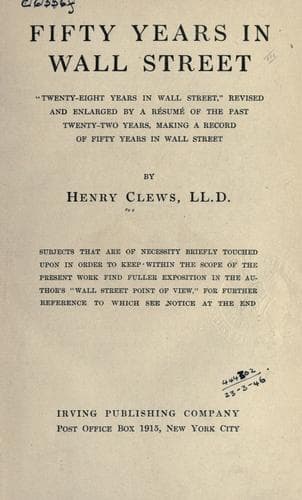
Business; Capitalists and financiers -- United States; Speculation; Wall Street (New York, N.Y.)
The crisis came in 1837, and was hastened by the “Specie Circular,”
which was the last official act of President Jackson, and which pricked
the bubble of inflation. This circular, which was issued from the
Treasury in July, 1836, required all collectors of the public revenue to
receive nothing but gold and silver in payment. The purpose of the
circular was to check the speculation in public lands, but it caused too
sudden a contraction in values, and created widespread disturbance in
business circles generally.
The public protest against the “Specie Circular” was so strong and
universal, that a bill went through both houses of Congress partially
repealing it. “Old Hickory” did not yield to Congress, however, and
though he did not veto the bill, he delayed signing it until after
Congress adjourned, thus preventing it from becoming a law.
The State banks sought to tide over the troubles arising from the
Jacksonian method of financiering by loans of public money to certain
financial concerns and individuals, but this plan only made matters
worse. There was a sudden expansion of paper money, which encouraged a
wild spirit of speculation and excessive importations, and imparted an
unnatural stimulus to business and commercial affairs. This state of
over-trading and reckless speculation was suddenly checked by bank
contractions, and in the spring of 1837 there were failures amounting to
$100,000,000 in New York city alone.
The shock was communicated to the entire country, and a state of general
paralysis in business circles ensued.
In the meantime the Bank of the United States continued in operation,
and did not even suspend in 1836, when its charter expired, but obtained
another charter from the State of Pennsylvania, which was entitled “An
Act to repeal the State taxes on real and personal property, and to
continue and extend the improvement of the State by railroads and
canals, and to charter a State bank to be called a United States bank.”
This United States bank did not expire until 1839, though it suspended
specie payment with the State banks in 1837, when by this method they
escaped a general collapse, and dragged through an agonising existence
for two years longer. The circulating notes and deposits of the Bank of
the United States were paid in full, but the $28,000,000 of capital were
a total loss to the stockholders, who never obtained a dividend. Such
were the good old times of financiering when General Jackson and his
successor, Martin Van Buren, sat in the Executive chair.
The entire capital stock of the bank was $35,000,000, of which
$7,000,000 were to be subscribed by the Government.
The real cause at the bottom of the failure of this bank was its error
of mixing up its legitimate business of banking with politics and
speculation, showing that keeping those matters as distinct as possible
is one of the great secrets of success in each of them.
Public-domain text, read in full here on John Shaqi.
Reviews
Reviews
No reviews yet
Be the first to share your thoughts on this work.
Elsewhere in the archive
Join the Discussion
Join the discussion
Sign in to leave a comment or review.
Sign InorCreate an account