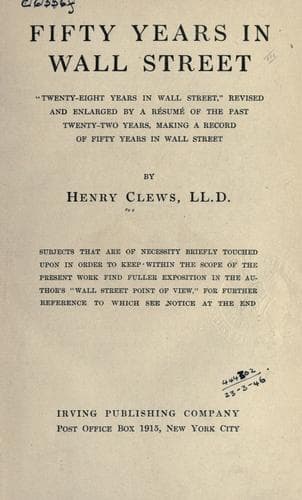
Business; Capitalists and financiers -- United States; Speculation; Wall Street (New York, N.Y.)
The panic of 1837 was further aggravated by the action of the Bank of
England which, in one day, threw out all the paper connected with the
United States. The banks on this side refused to discount paper, and as
a retaliatory measure in self-defense the business men and speculators
withdrew their deposits from the banks. This had a tendency to cripple
business still more, and cause utter prostration. In their selfish
frenzy bankers and merchants completed the ruin of each other, hastening
the catastrophe from their inability to take a broad, cool and generous
view of the situation.
There was a general suspension of the New York banks on May 10, 1837,
and the banks throughout the country followed in their wake within a
week afterwards, producing a financial convulsion unparalleled in the
history of the Republic. The country was brought to the verge of
bankruptcy from the effects of which a long time was required for
recovery.
After two years’ struggle to regain the credit and stability lost
through false methods of financiering, the banks suffered a relapse, and
underwent a severe process of weeding out the weakest, nearly one-third
of which happened to be of this description. Out of 850 banks, 343
closed their doors permanently.
The Sub-Treasury at New York was established the following year, 1840,
by an act of Congress which provided that the officers of the Government
should keep the public funds in their own custody, that coin alone
should be received in payment to the United States, and bank notes were
to be no longer received and paid out at the Treasury.
While this short chapter deals with matters which go back beyond my
personal recollections of twenty-eight years in Wall Street, still as
the panic of 1837 was the first of the great upheavals of its kind, that
had a marked effect on Wall Street affairs, it properly falls within the
scope of this book to chronicle the chief incidents of that great
business convulsion.
For this reason, therefore, I find room for it, in some measure
commensurate with its importance, and the space which can be afforded to
it, as a matter of financial history, the facts of which were still
fresh in the recollection of several speculators, bankers and business
men, with whom I had the honor of being acquainted shortly after my
advent in Wall Street immediately succeeding the panic of 1857.
Of those who gave me lively descriptions of their vivid recollections of
that panic, but few now survive.
I think, therefore, it is well for me to do my part in helping to
preserve the leading features of this important episode in the early
history of Wall Street, as there will soon be none of those, who took an
active part in the exciting events of that period, left to tell the
tale.
------------------------------------------------------------------------
CHAPTER XX.
THE TRUE STORY OF BLACK FRIDAY TOLD FOR THE FIRST TIME.
Public-domain text, read in full here on John Shaqi.
Reviews
Reviews
No reviews yet
Be the first to share your thoughts on this work.
Elsewhere in the archive
Join the Discussion
Join the discussion
Sign in to leave a comment or review.
Sign InorCreate an account