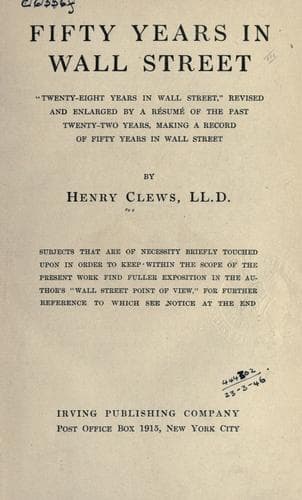
Business; Capitalists and financiers -- United States; Speculation; Wall Street (New York, N.Y.)
The Head Centre of this gold conspiracy needs no introduction here, as I
have attempted to do him ample justice in another chapter. He was also
the power behind the throne in Erie as well as in the Gold clique. He
pulled the wires while Fisk was the imposing factotum who was exhibited
to an admiring public. He managed the courts, the judges and the
lawyers, while Fisk got the reputation of doing this fine work, but was
simply the mechanical executive. He had made himself solid with the
Legislature also, and had acquired a hold on Erie that enabled him to
use that property just as he pleased for his own personal benefit,
ambition and purposes.
Erie was a mighty power at that time, with a wonderful leverage for
raising money. When cash was needed to purchase another railroad, a
legislature or a court, all that was necessary was to sell a few hundred
thousand of Convertible Bonds and turn them into Erie shares. Mr. Gould
was thus fortified with ample means of raising money on call at the time
he played the heavy role in the events which culminated in the disaster
of Black Friday.
Though the circumstances at that time were all in favor of success in
such a plot, it required a mind with great grasp and wonderful powers of
generalization to take advantage of all the bearings of the situation,
and to utilize everything toward the great end in view. Gould did his
work as chief of the conspiracy with rare tact and marvellous sagacity.
A resume of the conspicuous points in the situation and the plot will
make this clear.
The supply of gold in the New York market then did not exceed 25
millions. The Government held less than 100 millions, and about
one-fourth of this was in the form of special deposits represented by
gold certificates, part of which were deposited in the banks and the
remainder circulating throughout the country. Gold was then being sold
by the Treasury at the rate of a million a month, in accordance with a
plan that had been adopted as the best financial policy, both for the
administration and the prosperity of the country. This had always a
tendency to keep the price down, but on account of the circumstances
briefly related in the beginning of this chapter, this policy of selling
gold, owing to our commercial relations, was no longer considered for
the best interests of the country, and Mr. Boutwell, with his coadjutors
in the Treasury, were bound to give ear to the opinions of the bankers
and business men in the interest of our export trade.
Public-domain text, read in full here on John Shaqi.
Reviews
Reviews
No reviews yet
Be the first to share your thoughts on this work.
Elsewhere in the archive
Join the Discussion
Join the discussion
Sign in to leave a comment or review.
Sign InorCreate an account