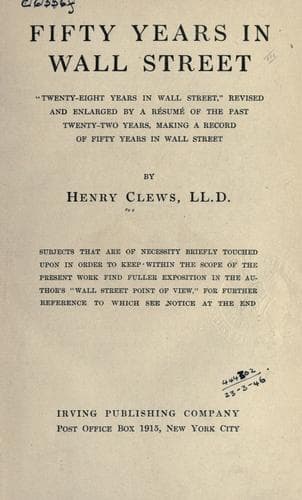
Business; Capitalists and financiers -- United States; Speculation; Wall Street (New York, N.Y.)
Although I am not much given to the sensational, I have collected a few
of the leading events in detail, which I think are worth putting in
permanent form, if I may presume that this book itself may happily
partake of that character.
The inside history of the conspiracy to put up the price of gold is also
full of interesting material, and shows how deeply laid the scheme was
to take advantage of the circumstances and of the feeling which existed
in favor of stimulating our exports at the time. I shall, therefore,
give an epitome of the salient points behind the scenes of the great
speculative plot, and the bold attempt made to involve President Grant
and his family in the conspiracy.
As I have intimated, Jim Fisk, Jr., or Jim Jubilee Junior, as he was
then popularly called, was eventually put forth as the active member of
the manipulating coterie. The clique made very good use of him, also, at
intervals during the period they were concerting their plans.
Fisk had originally been a peddler in New England, as his father had
been. He appeared in Wall Street a few years previous to the great gold
conspiracy as one of the confidential men of Daniel Drew. Having shown
that he was too sharp for some of the people in the broker’s office
where Mr. Drew made his headquarters, he received a polite hint that his
presence there was undesirable. Mr. Fisk then opened an office of his
own, and united his speculative fortunes with those of Mr. William
Belden. The name of the firm was Fisk & Belden. It was of but short
duration. It seems that they had difficulty in finding bankers to
accommodate them to the extent required, and they closed up the
business. But though Fisk failed of success in this instance as a
broker, his resources were not by any means exhausted. He made himself
generally useful to Mr. Drew, who still adhered to him.
As the result of this friendship and his own smartness, in a short time
afterwards Mr. Fisk was elected to the directory of the Erie Railroad
Company, and Mr. Drew, who had forwarded his interest in that direction,
was left out. This is an instance of the way Fisk made the best use of
his friends.
As the result of Fisk’s election to the Erie Board, forty thousand
shares of new stock were issued. Bold attempts were made to gobble up
other railroads through the same instrumentality. Fuller information on
these matters is given in my chapters on Drew, Gould, and the struggle
with Vanderbilt.
Fisk began to be considered a universal genius at that time, and had
acquired the sobriquet of Prince of Erie. Though he had no money to
operate with when he made his debut in Wall Street, soon after this
large issue of Erie stock, he began to show signs of wealth very
rapidly. He had the reputation of being the fortunate owner of several
railroads and steamboats, an opera house, at least one bench of judges,
an unlimited number of lawyers and a bevy of ballet girls.
Public-domain text, read in full here on John Shaqi.
Reviews
Reviews
No reviews yet
Be the first to share your thoughts on this work.
Elsewhere in the archive
Join the Discussion
Join the discussion
Sign in to leave a comment or review.
Sign InorCreate an account