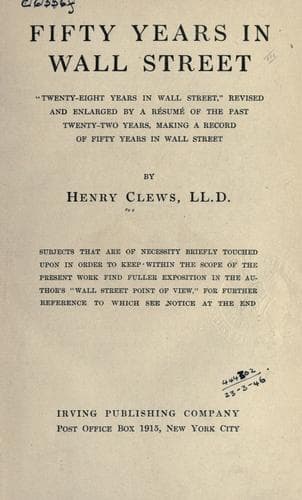
Business; Capitalists and financiers -- United States; Speculation; Wall Street (New York, N.Y.)
These funds were so managed that a very tight squeeze could, at almost
any time, be effected in the money market. The city funds on hand were,
at that time, usually about from six to eight millions of dollars, and
were deposited in the banking institutions of the “Boss.” They were
ostensibly under the control of the City Chamberlain, who was under the
control of Tweed.
Henry N. Smith and a few other favorite members of the syndicate would
draw their balances from these banks, making money scarce to the general
public, and the money market would suffer a sudden squeeze, and
consequently the stock market would break, sometimes with such rapidity
as to produce disastrous results to a number of brokers, business houses
and other financial concerns outside the Tweed Ring.
On one of these occasions Mr. Smith drove up to the Tenth National Bank,
the Black Friday ring institution, in a cab, and drew his balance
therefrom, amounting to $4,100,000. He took it home and kept it there
several days under lock and key. In the meantime Mr. Tweed and his
companions withdrew from circulation the greater portion of the amount
under their immediate control, making a tie-up, on the whole, of nearly
twenty millions of dollars. At that time this was an amount sufficient
to make a very stringent money market, and cause Wall Street operators
to feel very uncomfortable. It was then a mighty power to be wielded by
a few unscrupulous men. At that time Mr. Smith considered himself worth
at least five million dollars. He lost most of this in the panic of
1873, largely in Western Union stock, as above stated, into which
Commodore Vanderbilt had kindly put him.
I have referred to the prominent part which Mr. Smith played in the
great speculative drama of Black Friday, in the scenes and incidents of
my chapter on that ever-to-be-remembered day in Wall Street
I shall, in another chapter, briefly review some of the methods to which
the Tweed Ring resorted to make speculation and politics play into each
other’s hands, and show how a bold attempt was made to add the control
of the National Treasury to that of New York.
------------------------------------------------------------------------
CHAPTER XXV.
KEENE’S CAREER.
Public-domain text, read in full here on John Shaqi.
Reviews
Reviews
No reviews yet
Be the first to share your thoughts on this work.
Elsewhere in the archive
Join the Discussion
Join the discussion
Sign in to leave a comment or review.
Sign InorCreate an account