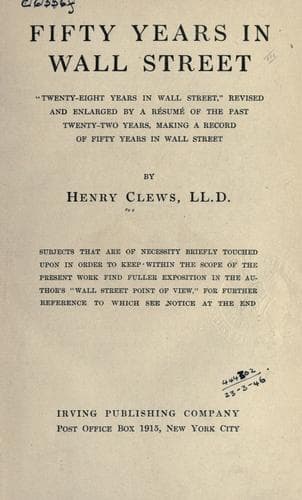
Business; Capitalists and financiers -- United States; Speculation; Wall Street (New York, N.Y.)
When Mr. Smith appeared before the Governing Committee of the Stock
Exchange to make application for the extension of time on his seat, he
made the following extraordinary statement: “On January 1, 1885, I was
worth $1,400,000. I had $1,100,000 in money, and the balance, $300,000,
in good real estate. On the following January I had lost the whole
amount, and was $1,200,000 in debt, a million of which I owed to Wm.
Heath & Co.”
Many people were surprised that Mr. Smith was enabled to obtain such an
enormous and unlimited amount of credit in one house. I took the ground
at the time, and I am still of the same opinion, that the animal
magnetism or psychologic power of Henry N. Smith over the elder Heath
was the real cause of all the trouble.
Mr. Heath had been in bad health for some time, consequently he left the
general management of the business to Mr. McCanless, the head clerk and
general manager of the firm, through whom the orders of Mr. Heath were
strictly executed.
Mr. Heath being weak in both body and mind, yielded his opinions to
those of Mr. Smith, by virtue of the superior mental force of the
latter.
In conducting a large Wall Street business it is necessary that a man
should have the mental stamina to say “no” firmly, and stand to it. In
order to be able to do this he must be backed up by a vigorous, healthy
physique.
The power to utter a negative in a determined manner requires,
generally, a fair degree of physical force, and it is absolutely
necessary to the success of a Wall Street broker that he should be able
to do it when occasion requires. A deficiency either in will power or
physical force to pronounce this small negative distinctly and firmly
may result in financial ruin, as it did in the case of Wm. Heath & Co.
Henry Nelson Smith made many successful turns in speculation during the
Tweed regime, owing to the facilities which the municipal bankers
belonging to that famous coterie afforded him for manipulating the money
market.
There were great fluctuations in stocks while William Marcy Tweed was
the power behind the throne in the government of the city of New York.
Mr. Tweed contributed largely towards these fluctuations. He and his
trusty companions pulled the wires at the City Hall while the puppets in
several of the brokers’ offices in the vicinity of Wall Street danced to
the sweet will of the managers in the municipal building.
One of Tweed’s three famous maxims was, “The way to have power is to
take it.” The other two were, “He is human,” and “What are you going to
do about it?” In conformity with the first maxim, Mr. Tweed took control
of the city funds, besides a number of the city savings banks, and other
financial institutions, which he had organized through special charters
from the Legislature, which he also owned during the period of his
Boss-ship.
Public-domain text, read in full here on John Shaqi.
Reviews
Reviews
No reviews yet
Be the first to share your thoughts on this work.
Elsewhere in the archive
Join the Discussion
Join the discussion
Sign in to leave a comment or review.
Sign InorCreate an account