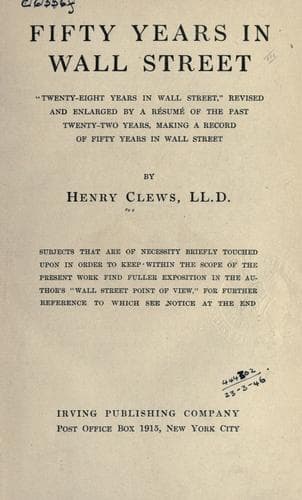
Business; Capitalists and financiers -- United States; Speculation; Wall Street (New York, N.Y.)
Perhaps I may best succeed in making myself understood on this
subject by illustrating the way in which our railroads are
usually built. Under the laws of the State of New York—which are
a fair sample of the laws of most other States—a number of
persons form a company under the general railroad laws,
registering at Albany the proposed route of the road, the amount
of capital stock and bonds to be issued, and a few other
particulars required in the papers of incorporation. The
incorporators then proceed to form themselves into a syndicate
or company, for the purpose of contracting to build and equip
the road. Here comes the first step in the system of “crooked”
financiering. In their capacity of incorporators, the same men
make a contract with themselves, in the capacity of
constructors. Of course, they do not fail to make a bargain to
suit their own interests. They would be more than human if they
did. Usually, the bargain is that the construction company
undertakes to build the road for 80 to 100 per cent. of the face
value of the first mortgage bonds, with an equal amount of
stock, and sometimes also a certain amount of second mortgages
thrown in, virtually without consideration. The first mortgages
are supposed to represent the real cash outlay on the
construction and equipment; but, as a matter of fact, the true
cash cost of the work done and materials furnished ranges from
60 to 80 per cent. of the amount of first lien transferred to
the constructors. The Construction Company disposes of the
bonds, partly by negotiating their sale to the public through
bankers, at an advance upon the valuation at which they had
received them, and partly by using them in payment for rails and
equipment. Beyond the profits made from building the road for
the first mortgage bonds, there remains in the hands of the
constructors the entire capital stock and any second mortgage
bonds they may have received, _as a clear bonus_, to be held for
future appreciation, and to keep control of the Company and be
ultimately sold on a market deftly manipulated for that purpose.
This is the way in which a large majority of our railroads have
been and others are still constructed. It will thus be seen that
the actual cash cost of a railroad is ordinarily less than 60
per cent. of the stock and bonds issued against the property,
and that its first mortgage exceeds the amount of the legitimate
actual cost of the road.
Public-domain text, read in full here on John Shaqi.
Reviews
Reviews
No reviews yet
Be the first to share your thoughts on this work.
Elsewhere in the archive
Join the Discussion
Join the discussion
Sign in to leave a comment or review.
Sign InorCreate an account