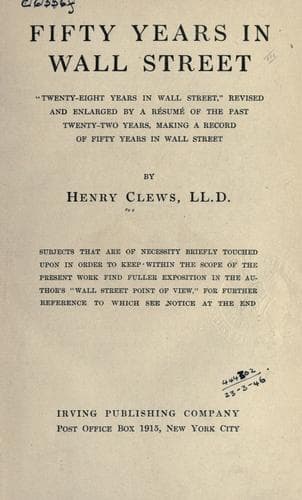
Business; Capitalists and financiers -- United States; Speculation; Wall Street (New York, N.Y.)
The basis of all the discredit, the embarrassments, the
bankruptcies and the robberies of our railroad system is thus
laid at the inception of the enterprises. They rest upon an
intrinsically rotten and dishonest foundation; and the evil is
far from having reached the end of its mischief to the
financial, political and social interests of the country. In
some few cases, railroads thus exorbitantly capitalized have
proved able to earn the interest on their debt, provide for
additional outlays on construction and betterments, and even to
pay dividends on their stock; but, in a large majority of cases,
they have had to undergo a process of financial reconstruction,
in order to bring the debts of the Company within its ability to
meet its fixed charges. It is not a risky estimate to suppose
that of our present 125,000 miles of railroad, with its
$7,500,000,000 of stock and debts, 60 per cent. has undergone
this process of debt-scaling and rehabilitation. Were it not
that the new roads have opened up new country for settlement,
which has become an immediate source of traffic, these bad
financial results would have been more general and worse than
they have proved to be. The risks attending the building of
lines into unsettled regions ought to have been a reason why
they should be constructed upon conservative principles; but, in
reality, the prospects of settling new populations and of
tapping new sources of wealth, have been so magnified to the
eyes of distant and credulous lenders as to enable the
speculative constructors to easily consummate their illegitimate
schemes.
The general result of this system of financiering has been to
deprive the legitimate original investors of their chances of
making a fair return out of their investment. As a rule, the
bondholders have provided all the capital expended, and the
stockholders have invested nothing. The bondholders incur all
the risks; the stockholders have no responsibilities. If the
enterprise proves a success, the bondholders get their interest,
while the stockholders, without a dollar of original outlay, get
vastly more than ever falls to the mortgage creditors through
the stock becoming an instrument of profitable speculation. If
the enterprise is a failure, the bondholder has to forego
interest and finally to accept a new mortgage for a less amount
and at a lower rate of interest; whilst the original stockholder
has, in the meantime, made money out of artificially “booming”
the shares in Wall Street.
Public-domain text, read in full here on John Shaqi.
Reviews
Reviews
No reviews yet
Be the first to share your thoughts on this work.
Elsewhere in the archive
Join the Discussion
Join the discussion
Sign in to leave a comment or review.
Sign InorCreate an account