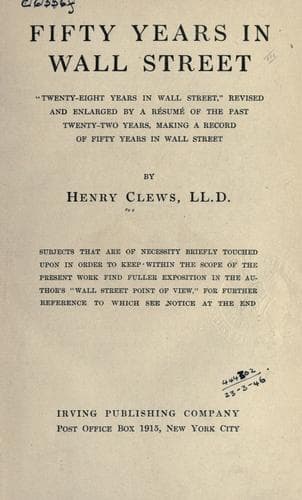
Business; Capitalists and financiers -- United States; Speculation; Wall Street (New York, N.Y.)
The Convention which had formed the free constitution of the State of
Louisiana in 1864 had been ordered to reassemble by its President. The
Confederate sympathizers, who had been greatly encouraged by the acts of
the President to keep alive their old feelings of hostility to the
North, resolved that the Republican Convention should not be permitted
to meet. The ground they urged for this proposed action was that the
Convention proposed to recommend the imposition of Negro suffrage upon
the State. There was a riot and a terrible massacre, in which over a
hundred lives were lost, and several hundred persons were wounded. The
municipal authorities of New Orleans gave aid and comfort to the
rioters.
The Congressional Committee that investigated the circumstances
connected with the riot reported that the President knew that riot and
bloodshed were apprehended. He knew what military orders were in force,
and yet without the confirmation of the Secretary of War, or the General
of the Army, upon whose responsibility these military orders had been
issued, he gave orders by telegraph, which, if enforced, as they would
be, would have compelled our soldiers to aid the rebels against the men
in New Orleans who had remained loyal during the war, and sought to aid
and support, by official sanction, the persons who designed to suppress,
by arrest and criminal process under color of the law, the meeting of
the Convention; and all this although the Convention was called with the
sanction of the Governor and by one of the judges of the Supreme Court
of Louisiana claiming to act as President of the Convention. The effect
of the action of the President was to encourage the heart, to strengthen
the hand, and to hold up the arms of those who intended to prevent the
Convention from assembling.
The President’s opposition to the Reconstruction Bill probably rendered
him more unpopular than any other executive act during his
administration. The bill was passed by large majorities in both Houses
of Congress.
The President’s repudiation scheme was another very unpopular
recommendation, for which he was very strongly reproved by the action of
Congress. He stated in his message of December, 1868: “That the holders
of our securities have already received upon their bonds a larger amount
than their original investments, measured by the gold standard. Upon
this statement of facts, it would seem but just and equitable that the
six per cent. interest now paid by the Government should be applied to
the reduction of the principal, in semi-annual instalments, which in
sixteen years and eight months would liquidate the entire national
debt.”
This clause of the President’s message was condemned by an almost
unanimous vote of both Houses.
Public-domain text, read in full here on John Shaqi.
Reviews
Reviews
No reviews yet
Be the first to share your thoughts on this work.
Elsewhere in the archive
Join the Discussion
Join the discussion
Sign in to leave a comment or review.
Sign InorCreate an account