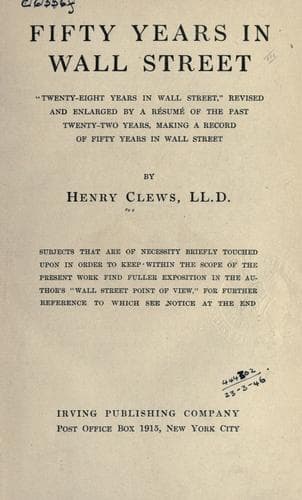
Business; Capitalists and financiers -- United States; Speculation; Wall Street (New York, N.Y.)
The great event in President Johnson’s career, however, was his
impeachment trial, which lasted from March 5 until May 26, 1868. He was
arraigned at the bar of the Senate, which was presided over by the Chief
Justice of the United States, the Hon. Salmon P. Chase.
The counsel of the President were Attorney-General Henry Stanberry, who
resigned his position to defend the President, ex-Judge Benjamin R.
Curtis, William S. Groesbeck, who acted as substitute for Judge “Jerry”
Black, and Hon. Wm. M. Evarts. General Benjamin F. Butler made the
opening argument against the President, accusing him of high crimes and
misdemeanors. Hon. Wm. Lawrence, of Ohio, posted him on the law of
impeachment. The chief charge in the articles of impeachment was the
removal of Mr. Stanton from the office of Secretary of War, in alleged
violation of the Tenure-of-office Act. According to this act Stanton had
a right to hold office during the term of the President by whom he was
appointed, and a month longer. He was appointed by President Lincoln.
The question to be decided then was whether Johnson was serving out
Lincoln’s unexpired term, or whether he was President _de facto_. Judge
Curtis took the latter ground, and argued, therefore, that Stanton’s
term had expired.
At the conclusion of the trial, the Senate was addressed against the
President by General John A. Logan and Mr. Boutwell. Thaddeus Stevens
attempted to read a speech, but was too weak. He handed his manuscript
to General Butler, who read it to the Senate, but it fell comparatively
flat. The Hon. Thomas Williams, of Pennsylvania, read a speech in favor
of impeachment, which was well received. The case on behalf of the
Senate was summed up by Hon. John A. Bingham, who arrayed all the
charges against the President in a very strong and unfavorable light.
His concluding sentences were, “I ask you, Senators, how long men would
deliberate upon the question whether a private citizen arraigned at the
bar of one of your private tribunals of justice, for criminal violation
of law, should be permitted to interpose a plea in justification of his
criminal act that his only purpose was to interpret the Constitution and
laws for himself; that he violated the law in the exercise of his
prerogative to test it hereafter, at such day as might suit his own
convenience, in the courts of justice? Surely, Senators, it is as
competent for the private citizen to interpose such justification in
answer to his crime as it is for the President of the United States to
interpose it, and for the simple reason that the Constitution is no
respecter of persons, and vests neither in the President nor in the
private citizen judicial power. For the Senate to sustain any such plea
would, in my judgment, be a gross violation of the already violated
constitution and laws of a free people.”
Public-domain text, read in full here on John Shaqi.
Reviews
Reviews
No reviews yet
Be the first to share your thoughts on this work.
Elsewhere in the archive
Join the Discussion
Join the discussion
Sign in to leave a comment or review.
Sign InorCreate an account