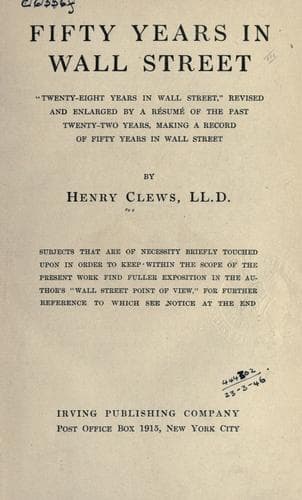
Business; Capitalists and financiers -- United States; Speculation; Wall Street (New York, N.Y.)
I replied: “Senator, I have a very high regard for Mr. Opdyke, as a man
of great ability, as well as a brother banker, but as we have, all of
us, a greater interest in what is to be done at this Convention, with a
view of re-electing General Grant, we must, in my judgment, sacrifice
all other interests thereto. Looking at the matter from that point of
view, I am bound to say, therefore, that George Opdyke is not our best
man. As you remember, he was Mayor of the city of New York at the time
of the great riots of 1863, which was the most critical period of the
country’s existence, and it was generally understood that in his
official capacity he showed the white feather. While I admit that the
excitement at the time was calculated to intimidate some of the
strongest hearts, still, Mr. Opdyke, as Chief Magistrate of the city,
was supposed to be equal to the emergency, and to meet it with firmness,
irrespective of personal danger. He was expected to be equal to the task
of ordinary self sacrifice in such a position, and he did not come up to
popular expectation.
“And you will recollect, Senator,” I continued, “that your own
brother-in-law, that able, worthy and popular man, Hon. Horatio Seymour,
was so far carried away by his predilections then, that he addressed the
crowd of peace-breakers as ‘friends.’ I confess that when a man like him
was so pronounced on that side it was a difficult matter for a Mayor to
have backbone enough to withstand the pressure. But public opinion is
not in the habit of making such fine distinctions to excuse want of
courage.
“If this is not an ample reason,” I said, “I can give you another, which
should be sufficient to determine that Mr. Opdyke is not our best man at
this time. He is young enough, however, and may be available at a future
period, when the asperities associated with these troublous times have
been fully smoothed down. During the war Mr. Opdyke had the misfortune
to be a special partner in a clothing manufacturing firm which had
received a contract from the Government to make clothing for the poor
fellows who were fighting our battles for the salvation of the country.
The clothing made by this firm was rejected on account of the
inferiority of the material, and this is said to have been the first
application of the term ‘shoddy’ to army clothing in this country.”
Mr. Conkling seemed to be amazed at my statement, and admitted that his
protegé would not do. He felt considerably embarrassed in regard to his
position with reference to Mr. Opdyke. He said, “Mr. Opdyke is here and
expects the nomination. Some one ought to tell him to withdraw.”
Thereupon Mr. A. B. Cornell volunteered to undertake this delicate duty.
He promptly performed it, and afterwards reported that the work had been
accomplished. He said that Mr. Opdyke at once consented to comply with
the modest request, but was so mad about it that he had left the city by
the first train for home, being unwilling to remain for the convention.
Public-domain text, read in full here on John Shaqi.
Reviews
Reviews
No reviews yet
Be the first to share your thoughts on this work.
Elsewhere in the archive
Join the Discussion
Join the discussion
Sign in to leave a comment or review.
Sign InorCreate an account