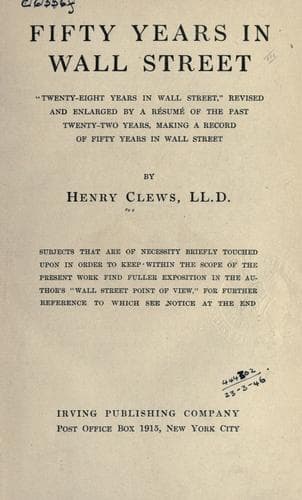
Business; Capitalists and financiers -- United States; Speculation; Wall Street (New York, N.Y.)
Prior to his departure, however, he had advised the Hon. W. H.
Robertson, who was the next prominent candidate, of his withdrawal, and
of the support of his constituency so far as his name could control it.
Mr. Robertson, who had been prominent in the preliminary canvass, was
gratified at this turn of affairs, and encouraged by his new accession
of strength. He was quick to embrace the opportunity now left open, as
there were no other candidates whom he feared. So the whole of that
night he worked arduously and faithfully for the object in view.
When I left the Conkling mansion next morning, after breakfast, I
mingled freely with the delegates, and found, from the efforts made the
previous night, that the nomination of Judge Robertson was a foregone
conclusion, and the candidate himself was sure of it. The Robertson boom
had become suddenly popular. In fact, it was in the air.
I was invited to General Arthur’s parlors, where the caucus had its
headquarters. It was customary with General Arthur, in those days, to
take parlors for that purpose at State Conventions. I found the rooms
filled with distinguished members of the party, and it was assumed by
all that Robertson was the candidate for Governor; it was also proposed
that we should march in a body to his hotel, to congratulate him, and to
assure him of the fact that we were all for him. I declined to be of the
number on that mission, to the great chagrin of some of my friends. When
asked for my reasons, I said that I had no feeling of personal hostility
towards Mr. Robertson, but as the New York _Times_ had not been pleased
with his conduct while State Senator, and had severely criticized him
thereafter, I felt satisfied that under no circumstances could we rely
upon the _Times_ to support our ticket if he were at the head of it; and
as that was the only paper in New York that we had to fight our battles
then, it was all important that we should nominate a ticket that would
not be antagonistic to it, in order that we might have its endorsement
and full co-operation.
The rest of the gentlemen went to pay their respects to Judge Robertson,
as pre-arranged, and during their absence I went to the telegraph office
and sent the following message to General John A. Dix, to his residence
at 3 West Twenty-first street, New York:
You are favored by many of the delegates for Governor. If
nominated will you accept? For the sake of the country, answer
in the affirmative.
“HENRY CLEWS.”
To this I received the following:
“I have telegraphed your dispatch to West Hampton, where my
father now is.
“Aug. 21 1872.
“JOHN W. DIX.”
Public-domain text, read in full here on John Shaqi.
Reviews
Reviews
No reviews yet
Be the first to share your thoughts on this work.
Elsewhere in the archive
Join the Discussion
Join the discussion
Sign in to leave a comment or review.
Sign InorCreate an account