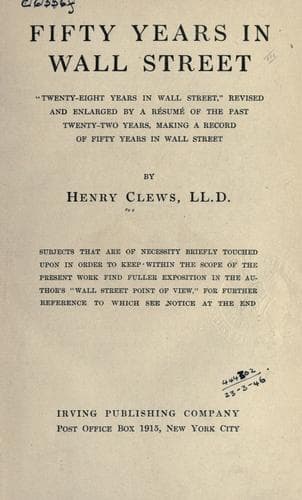
Business; Capitalists and financiers -- United States; Speculation; Wall Street (New York, N.Y.)
So I immediately went there by night train and saw the Secretary early
in the morning at the Treasury, and told him I had come on behalf of the
combination I had formed, to make him a direct offer at his own
price—94—for the unsold 1884 bonds. He was evidently pleased and
surprised by the apparent improvement in the demand for them. He said,
however, with a fine sense of probity, and consideration for the rights
of others, that while he was glad I had come to Washington, and made the
proposition to take the balance, he did not think it would be fair to
those who had bid and whose bids were thrown out, to sell the rest of
the issue without first notifying them of the new offer, and giving them
the option of taking what they wanted at the price I offered—94.
He asked me to call again the next morning, after he had given the
matter further consideration, and I did so. But meanwhile I had talked
with many Southern politicians and office-holders, Peter G. Washington,
one of the Virginia Washingtons, among them, and seen so much of the
extensive war preparations which were being made in and about
Washington, that I came to the conclusion that a long and very bitter
war lay before us, notwithstanding that Mr. Chase had the day previously
assured me that it would all blow over, with peace restored, within
sixty days, a prediction that was echoed by Secretary of State Seward a
little later. I was particularly impressed by what Mr. Washington,
himself a prominent Government official, had told me of Southern
sentiment and Southern determination to fight till all was lost or
gained, and by his and other Southerners’ absolute but mistaken
confidence that the South would establish its own Confederacy, however
long a war it might take to do it. The South in seceding from the Union
expected to be able to establish a slave oligarchy, for in Lincoln’s
election it foresaw the doom of slavery, as both he and the Republican
party were pledged to work for its abolition. Yancey and the other
leading Southern “fire eaters” were responsible for this false view.
When I made my second call upon Mr. Chase, I said: “Since I saw you
yesterday, Mr. Secretary, I have heard so much in conversation with
Southern politicians and office-holders at the hotels, and seen and
heard so much of the extensive war preparations on both sides, that I am
convinced the war will be a long one, and I fear we shall see much lower
prices for Government bonds and securities of all kinds. Feeling as I
do, therefore, in justice to those I represent and who have given me
full power to use my own discretion in the matter, I must withdraw the
offer I made you yesterday. Had you accepted my offer at the time, of
course I would have considered the transaction closed, and taken the
bonds without question, but as it is, you will admit I am under no
obligation, and free to retire.”
Public-domain text, read in full here on John Shaqi.
Reviews
Reviews
No reviews yet
Be the first to share your thoughts on this work.
Join the Discussion
Join the discussion
Sign in to leave a comment or review.
Sign InorCreate an account