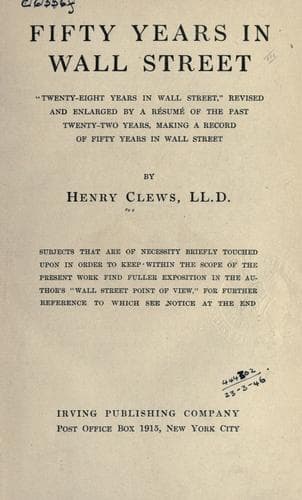
Business; Capitalists and financiers -- United States; Speculation; Wall Street (New York, N.Y.)
After this, the Commodore started a line of steamers in opposition to
the fleet of Pacific Mail, and kept his boats running until he was
bought off. About this time an event happened which has preserved for
posterity a good story, highly characteristic of the Commodore. His
son-in-law, James M. Cross, had conceived the idea of embarking in the
wholesale leather business in the “Swamp.” He had been talked into it by
an experienced man who was to be his partner. A store was secured, and
everything put under way for the start, with the exception of the
capital, which Mr. Cross had agreed to contribute against the experience
of his partner. The amount was to be $50,000. Mr. Cross, knowing that
the Commodore had at this time become rich and prosperous, felt
satisfied that it was only necessary to make application to his
enterprising father-in-law for the amount required. Thereupon, with the
confidence begotten of implicit trust, he approached the Commodore for
this temporary accommodation, giving him a full description of the
nature of the business. After listening attentively to the statement of
his esteemed son-in-law, the Commodore said in reply: “Now, James, if I
let you have this $50,000 to put in the leather business, how much do
you think you will be able to make for your share out of the profits?”
Mr. Cross thought the best position to take with a rigid business man
like his father-in-law was to be prudently conservative in his
expectations, and to keep all his Colonel Seller prospects in the
background. After a few moments reflection he replied: “I believe I am
almost certain to make $5,000 a year.” The Commodore promptly responded:
“James, as I can do better than that myself in handling $50,000, I will
give you $5,000 a year hereafter, and you may consider yourself in my
employ at that salary.” There was no way for James to wriggle out of it,
and he accepted the situation with apparent good grace, whatever his
internal emotions may have been at the time. The Commodore forthwith
dispatched Mr. Cross to San Francisco to manage his steamboat business
there. He soon discovered, however, that James was hardly aggressive
enough for the go-ahead fellows on the gold coast, and he was recalled.
After looking around some time for a man possessing the necessary
requirements to be placed in successful competition with the adventurous
spirits of the Pacific Slope, his search was rewarded by an introduction
to Commodore C. K. Garrison, then in command of a Mississippi steamboat.
Garrison had established his reputation for being the best euchre player
on the river, and for much besides which that term implies. He was brave
and fearless—in fact, in some respects, a Jim Bludso of real life, with
the self-sacrificing qualities of that hero largely discounted, or
perhaps entirely left out. It required men of mettle in those days to
run a steamboat on the Father of Waters, when the greater portion of the
Public-domain text, read in full here on John Shaqi.
Reviews
Reviews
No reviews yet
Be the first to share your thoughts on this work.
Elsewhere in the archive
Join the Discussion
Join the discussion
Sign in to leave a comment or review.
Sign InorCreate an account