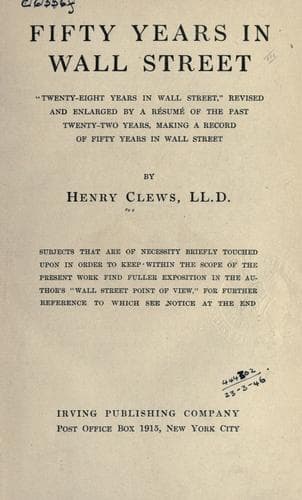
Business; Capitalists and financiers -- United States; Speculation; Wall Street (New York, N.Y.)
passengers belonged to the gambling fraternity, and were all experts
with the bowie knife and the ready revolver.
The Commodore had an interview with Garrison, which resulted in an
engagement, and he was sent to San Francisco as the Commodore’s agent.
It was soon found that he was the man for the Wild West, and he was not
slow to appreciate his own value and importance to the increasing
fortunes of his employer. He struck very often for higher wages, and was
always able to command his price. He rose, from one advance to another,
until his salary at that day had reached the marvellous figure of
$60,000 a year. Numerous stories of Garrison’s fabulous prosperity on
the Pacific Coast reached this city and the ears of the Commodore, and
his fame began to penetrate farther than the name of the latter had ever
been heard. These accounts had their effect on a mind so naturally
envious as that of the Commodore. He began to realize the humiliating
fact that, instead of Garrison being in his employ, the former captain
of the Mississippi steamboat had him in tow, and was everywhere regarded
as the Boss, while Vanderbilt was simply supposed to be his Eastern
agent. This brought matters to the point where patience ceased to be a
virtue, and the connection was severed. Soon after this the Commodore
sold out to the Pacific Mail Company, which again became a monopoly, and
as the fight had been a losing one to him, he was obliged to find other
waters for his boats.
Since his advent with a common row boat on the waters of our own
handsome bay, thence through the gradations of ferry boats and
steamboats, nothing but unremitting success had attended his ventures,
until his unequal struggle in competition with Pacific Mail. He appeared
to have met his Trafalgar when he encountered that fleet. His
dissociation with Garrison seemed for a time to forebode disaster. He
gathered himself up temporarily again, but never took to the waters so
kindly afterwards. He began to feel that his financial destiny was
verging towards a firmer foundation. His last boat was the famous
steamship Vanderbilt, which was recognized at the time as one of the
finest ships to be found on any sea. He made a present of her to the
Government during our great National struggle, or according to another
account, he lent her, and the Government kept her. The Commodore at one
time had a fleet of sixty ships.
The Commodore became convinced that the growing prospects of railroads
pointed to greater facilities for transportation in the future, and also
a more profitable investment than those watery regions which had
hitherto appeared to be his natural element. He promptly resolved to
turn his back on the domain of Neptune, and to devote his great energies
to enterprises on land. He saw there was comparatively little room for
development in water traffic, while in the railroad business the field
was practically unlimited.
Public-domain text, read in full here on John Shaqi.
Reviews
Reviews
No reviews yet
Be the first to share your thoughts on this work.
Elsewhere in the archive
Join the Discussion
Join the discussion
Sign in to leave a comment or review.
Sign InorCreate an account