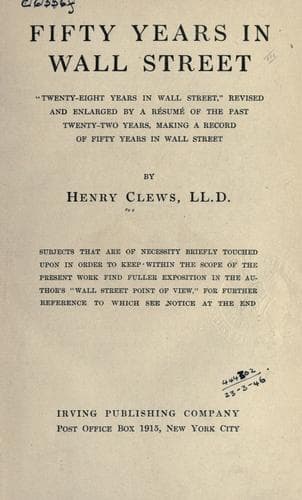
Business; Capitalists and financiers -- United States; Speculation; Wall Street (New York, N.Y.)
this time, it is said, that the Commodore began to correct his judgment
regarding the “executive ability of William H.,” and the latter relaxed
no effort to please his exacting father in everything, taking all his
abuse without complaint or anger. After the Commodore secured control of
the Harlem road, which was his first great railroad venture, he made
William H. Vice-President. As a co-worker with his father the latter
further demonstrated his capacity for railroad management, and Harlem
stock, which had been down to nearly nothing, in a few years became one
of the most valuable railroad properties in the country. So, it is a
fact, although not generally known, that William H. Vanderbilt had
proved himself to be a competent railroad manager before his eminent
father had fairly begun that line of business. It was almost entirely
owing to his individual exertions and sound judgment that, in a few
years, the Harlem road was double-tracked, and such other improvements
made as sent the stock from 8 or 9 to above par. The Commodore was so
highly pleased and agreeably surprised with his son’s management of the
Harlem road that he made him Vice-President of the Hudson River Railroad
also, and at a later date associated him in the same capacity with the
management of the important consolidation of New York Central & Hudson
River. The great executive power of William H. was manifested in every
successive movement which his father directed, and unparalleled
prosperity was the result in every instance. After William H. was fully
installed in the Vice-Presidency of the consolidated system of the
Vanderbilt railroads he became an indefatigable worker, taxing his
physical and mental powers to their utmost capacity, and it was
doubtless this habit of hard work, persisted in for many years, that
resulted in so sudden and comparatively premature death for a member of
a family famous for its longevity throughout several generations. He
insisted on making himself familiar with the smallest details of every
department, and examined everything personally. He carefully scrutinized
every bill, check and voucher connected with the financial department of
the immense railroad system, and inspected every engine belonging to the
numerous trains of the roads. In addition to this general supervision of
everything that pertained to the railroads, he was in the habit of going
over a large amount of correspondence which the majority of other men
not possessing the hundredth part of his wealth hand over to their
clerks, and he answered a great number of letters with his own hand
which financiers of comparatively moderate means are in the habit of
dictating to their stenographers. When his father died, at the age of
82, in January, 1887, William H. Vanderbilt, then 56 years of age, found
himself the happy possessor of a fortune variously estimated at from 75
to 90 million dollars. The remainder of the Commodore’s bequests
amounted to 15 millions.
Public-domain text, read in full here on John Shaqi.
Reviews
Reviews
No reviews yet
Be the first to share your thoughts on this work.
Elsewhere in the archive
Join the Discussion
Join the discussion
Sign in to leave a comment or review.
Sign InorCreate an account