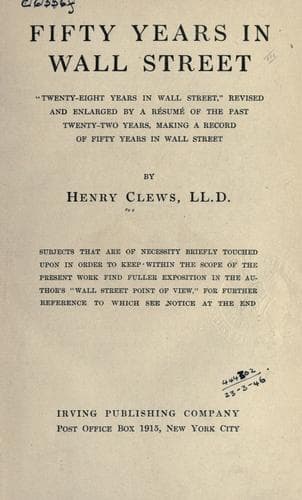
Business; Capitalists and financiers -- United States; Speculation; Wall Street (New York, N.Y.)
After the death of his father the executive powers of Wm. H. Vanderbilt,
in the management of the vast railroad interests bequeathed to him, were
called into active play. The great strike of 1877 among the railroad
employes threatened to paralyze business all over the country, and came
pretty near causing a social revolution. In this emergency a cool head
and prudent judgment were valuable attributes to a railroad manager. Mr.
Vanderbilt proved that he possessed both in more than an ordinary
degree. Just prior to encountering the knotty problem of the strike he
had been highly instrumental in bringing about suspension of hostilities
in the freight war, and the course which he advised led to an
arrangement that produced harmony among the trunk lines for a
considerable period. As a consequence of the rate war the railroad
companies were obliged to cut down the wages of their employes, and this
was the chief element in causing the strike. There were 12,000 men in
the employ of the New York Central and Harlem. Their wages had been
reduced ten per cent. and they had threatened to annihilate the Grand
Central Depot. Instead of making application to have the militia called
out, as had been done in Pennsylvania, Mr. Vanderbilt—although a man
possessed of far more than ordinary courage—with keen foresight proposed
a kindly compromise with his employes. He telegraphed from Saratoga to
his head officials an order to distribute $100,000 among his striking
employes and promising them a restoration of the ten per cent. reduction
as soon as business improved to a point justifying such an advance. This
prompt and prudent action had the desired effect, and the consequence
was that while there was a small insurrection in Pittsburgh, and bloody
war to the knife, at great cost to Allegheny County, calmness reigned in
the prominent railroad circles of New York, and the taxpayers escaped
the burden that might otherwise have been put upon their shoulders, and
the demoralizing effects of violence and bloodshed were prevented. Over
11,500 of the 12,000 men returned to work, thus showing their gratitude
to Mr. Vanderbilt and faith in his promise, which was afterwards duly
fulfilled. The policy of Wm. H., in the management of his great railroad
system, unlike that of his father, was entirely pacific in its
character. He was disposed to settle all misunderstandings by reason and
arbitration, and had no inclination for fighting and conquest, after the
manner of the Commodore. Although a very close calculator in business
matters, a habit to which he adhered even to the precision of striking
out superfluous items which should not have been charged in his lunch
bill, Mr. Vanderbilt was in many respects generous to a fault. He
compromised the suit with his brother, “Young Corneel,” allowing him the
interest on $1,000,000, whereas his father had only left him the
interest on $200,000, with a forfeiture clause in the event of “Corneel”
contesting the will. Wm. H.
Public-domain text, read in full here on John Shaqi.
Reviews
Reviews
No reviews yet
Be the first to share your thoughts on this work.
Elsewhere in the archive
Join the Discussion
Join the discussion
Sign in to leave a comment or review.
Sign InorCreate an account