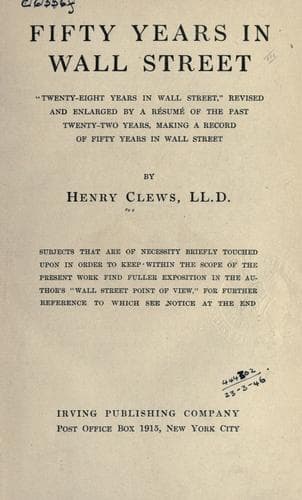
Business; Capitalists and financiers -- United States; Speculation; Wall Street (New York, N.Y.)
Congress, seeing that this contraction tended to produce stringency in
the money market, and handicapped the Government’s agents in the sale of
its securities, had, on August 5, 1861, suspended the act of August 6,
1846, “providing for the better organization of the Treasury, and for
the collection, safe-keeping, and disbursement of the public revenue.”
It did this so as to permit the Secretary of the Treasury to deposit any
of the money obtained on authorized loans in such solvent specie-paying
banks as he might select, and, in addition, it expressed this in a
resolution. The resolution was promptly acted upon by Secretary Chase,
and this, and a later law, governed the policy of the Treasury ever
afterwards. Monetary stringency was thus avoided by the Treasury keeping
as much of its money in the banks as it could, and so locking up as
little as possible in the Treasury and Sub-treasuries. The evil effects
of the Sub-treasuries system in locking money out of circulation was
thus practically acknowledged and guarded against.
When the sale of the 7-30s had been completed by the Government agents,
there was great pressure brought to bear by the banks throughout the
country, who were backed by many influential newspapers, in favor of
giving the sale of the 5-20s to the banks instead of to the Government
agents. The pressure upon Secretary Chase became so great that he
concluded to try the experiment, and authorized all the banks throughout
the country to sell the 5-20s. After giving them every opportunity to
supersede the agency system, as previously adopted with the six per
cent. and the 7-30 Treasury notes, the Secretary was finally compelled
to abandon the banks and go back again to the agents, who took hold with
vigor and made the sale of the 5-20s as brilliant a success as they had
previously made that of the 7-30s. We were friendless in Europe, but we
overcame this by patriotism and energy at home.
After a time, some of the banks, and there were only State Banks then,
threw out the Demand Notes, and so it became necessary to enforce their
circulation. To accomplish this, Secretary Chase asked Congress to make
them a legal tender for the payment of all debts, public and private,
excepting customs duties, and interest on the public debt, payable in
coin.
Congress, therefore, on February 25, 1862, remedied the difficulty by
passing the Legal Tender Act, making these and all the United States
notes lawful money. In the same act it authorized the issue of
$150,000,000 of new non-interestbearing legal tender notes. The
provision for the payment in coin of customs duties and interest on the
bonded debt was obviously as necessary as it was wise, as customs duties
furnished the means for paying the interest in specie; and the fact of
its being payable in gold created a demand for our bonds in other
countries, as well as at home, which would not have existed on paper
money interest.
Public-domain text, read in full here on John Shaqi.
Reviews
Reviews
No reviews yet
Be the first to share your thoughts on this work.
Join the Discussion
Join the discussion
Sign in to leave a comment or review.
Sign InorCreate an account