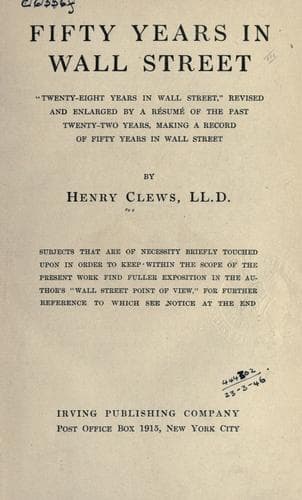
Business; Capitalists and financiers -- United States; Speculation; Wall Street (New York, N.Y.)
There are many popular delusions outside the ranks of the clergy
connected with the effort to form a correct estimate of Wall Street
affairs by the general public. It is a popular delusion that it is a
place where people who are in the “ring” take something for nothing. No
idea could be further wide of the mark in regard to Wall Street men as a
class, however true it may be of some individual instances, as in other
departments of business. Wall Street gives full value for everything it
receives, and the country at large is deeply its debtor. Some people may
think this a paradox, but there is nothing more easily demonstrated to
those who have observed the commercial and industrial progress of the
country and the age.
Wall Street has furnished the money that has set the wheels of industry
in motion over the vast continent, and in one century has brought us
abreast, in the industrial arts, of countries that had from one to two
thousand years the start of us. In this respect it has assisted nobly to
carry out the ideas of the fathers of the Constitution. Washington,
Jefferson, Madison, Franklin and Hamilton laid down the doctrine that it
would be a betrayal of the interests of posterity to limit the
productive energies of this country to raw material. With our present
experience we may think it strange that this question should ever have
been debated, but it was, even after the old tyranny had been obliged to
loosen its grasp on the struggling enterprise of the young Republic. Our
old revolutionary sires deserve credit for their foresight, but what
would have been the fate of their commercial philosophy if Wall Street
had not supplied the sinews of war to cope with the forces of nature, to
work our mines and build our railroads, and through these and other
means, to attract the teeming population from every clime to cultivate
our virgin soil and develop our wonderful industries and resources?
Apropos of the above observations, I may add that during the debate in
the British Parliament, on the recognition of the Confederacy, the great
manufacturing power in our industrial, financial and commercial progress
was clearly exhibited and thoroughly appreciated by British statesmen.
It was made one of the strongest arguments, too, by some of the
representatives of our jealous and envious cousins on the other side of
the “pond,” why Great Britain should recognize and aid the South in the
war. Lord Salisbury, then Lord Robert Cecil, at present the leader of
the Tory party in England, and the advocate of twenty years’ coercion
for Ireland, was one of the bitterest foes of the Union, chiefly on this
account. He was one of the Vice-Presidents of the “Southern Independent
Association,” for the promotion of the cause of the Rebellion, and for
supplying the Confederates with money and arms, and for the ultimate
object of founding an empire of slavery on this continent.
Public-domain text, read in full here on John Shaqi.
Reviews
Reviews
No reviews yet
Be the first to share your thoughts on this work.
Join the Discussion
Join the discussion
Sign in to leave a comment or review.
Sign InorCreate an account