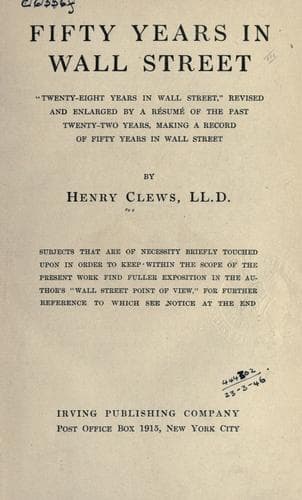
Business; Capitalists and financiers -- United States; Speculation; Wall Street (New York, N.Y.)
Slidell and Mason went to Europe in January, 1862. This was perhaps the
darkest and most critical period for the cause of the Union during the
great struggle. The Commissioners carried letters with them showing the
inefficiency of the blockade of the Southern ports, the great
disadvantages and losses suffered by England and France through cutting
off the cotton supplies, and setting forth the enormous advantages that
would result if free trade with the Confederacy were established. These
were strong arguments to arouse the spirit of commercial selfishness in
favor of the South.
The ambitious designs of Napoleon were of a very towering and extensive
character. He not only expected to recover Louisiana, which his uncle in
an hour of necessity had sold to the United States, but he aimed at the
restoration of the entire old colonial empire of France on this
continent.
The Emperor was thoroughly posted in the affairs of this country. It
seems that while he had resided in a small room in Hoboken, and took his
meals at a twenty-five cent restaurant, paying for them with money
borrowed from French patriots, on the very slim prospect of reaching the
throne of France, he made the best use of his time, and he had studied
the history and geography of the United States and Canada with great
care and accuracy.
In justice to his character for gratitude, however, it must be said, in
passing, that, like young “Corneel” Vanderbilt, he paid all the money he
borrowed, and placed some of his New York and Hoboken creditors in good
positions at the Tuileries, under the Second Empire. He never forgot a
favor nor forgave an injury.
The Emperor’s knowledge of American affairs, as well as his ambitious
designs, were briefly, but at the same time very fully disclosed, in
conversation with Mr. Benjamin, at the Villa Eugenie, at Biarritz. “He
turned with peculiar and undisguised eagerness,” said Mr. Benjamin, “to
the Mexican question. He knew the very number of guns on the Morro, the
sums the United States had spent on the fortifications in Florida, the
exports and imports of Galveston and Matamoras, in fact everything which
well informed local agents could have reported to an experienced
statesman eager for information. He examined me again on Texas and its
population, the disposition of the French residents, the tendencies of
the German colonists, the feeling on the Mexican frontier. He observed
that Louisiana was nothing but French at the bottom. I was fully
persuaded that he proposed to seek in Mexico a compensation for the lost
colonies in the West Indies, which, he said, could not be recovered,
‘_sans nous brouiller avec nòs allies_,’ (without embroiling us with our
allies). He insisted upon it that France must, sooner or later, have a
foothold (_pied à terre_) on the Florida coast, for the purpose of
protecting her commerce in the Gulf, for, he added, ‘_Nous ne voulons
pas d’un autre_ _Gibraltar de ce côté là_,’ (we don’t want another
Gibraltar on that side.”)
Public-domain text, read in full here on John Shaqi.
Reviews
Reviews
No reviews yet
Be the first to share your thoughts on this work.
Elsewhere in the archive
Join the Discussion
Join the discussion
Sign in to leave a comment or review.
Sign InorCreate an account