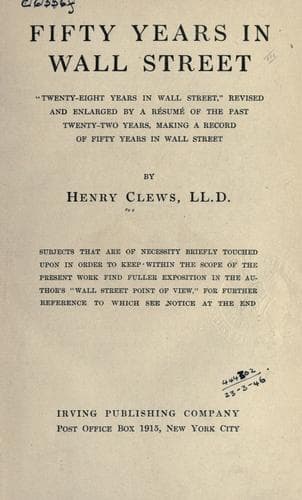
Business; Capitalists and financiers -- United States; Speculation; Wall Street (New York, N.Y.)
Mr. Slidell’s predecessor at Paris, Mr. Rost, had received assurance
from the Duc de Morny, who was then next to the Emperor in his knowledge
of State affairs, that the South would be recognized. It was only a
question of time. After consulting with M. Thouvenel, Minister of
Foreign Affairs; Persigny, Minister of the Interior; Fould, Minister of
Finance; Rouher, Minister of Commerce; Baroche, President of the Council
of State; Mocquard, Private Secretary of the Emperor; Count Walewski, De
Morny and others, Slidell was satisfied that the Emperor was all right,
and he wrote to Jeff. Davis & Co. as follows:
“The Emperor has invited the English Government to join with him
in recognizing the South, but the English Government, owing to
Earl Russell, has refused to act simultaneously with him.”
This statement of Slidell was true in one sense, but it was not strictly
and diplomatically correct. There is no doubt that the English
Government would have been anxious enough to join the Emperor in any
scheme of conquest and spoliation that had a fair promise of success,
and an average chance of avenging the Boston Tea Party and the Battle of
Bunker Hill, but both powers were playing at the game of diplomacy, each
for the purpose of making the other responsible for taking the
initiative in the recognition of the South. They were both very
circumspect about committing themselves, and the Palmerston-Russell
Cabinet, with that caution which always characterized old “Pam” in
foreign affairs, would not recognize any suggestion from the Emperor
that did not bear his signature. The Emperor thought to make use of a
Mr. Lindsay, a wealthy shipowner and member of Parliament, to draw out
the English Government, but the latter was not to be committed to any
course of policy that might involve important responsibilities in the
future through any second-hand authority.
The Emperor seemed to have opened his mind very freely to Mr. Lindsay.
He told him that he would have taken steps to put an end to the blockade
of the Southern ports if the English Ministry had intimated a
willingness to act with him. He said he had forwarded intimation to this
effect through Mr. Thouvenel, but had not received a satisfactory
answer. He intimated that if England was ready, he was, and was prepared
at once to despatch a formidable fleet to the Mississippi, on condition
that England should send an equal force to demand free ingress and
egress for their merchantmen, and for the cargoes of goods and supplies
of cotton which were necessary to carry on the commerce of the world.
Napoleon was resolved to act, as he had always done, on the high ground
of conferring universal favors on humanity.
Public-domain text, read in full here on John Shaqi.
Reviews
Reviews
No reviews yet
Be the first to share your thoughts on this work.
Elsewhere in the archive
Join the Discussion
Join the discussion
Sign in to leave a comment or review.
Sign InorCreate an account