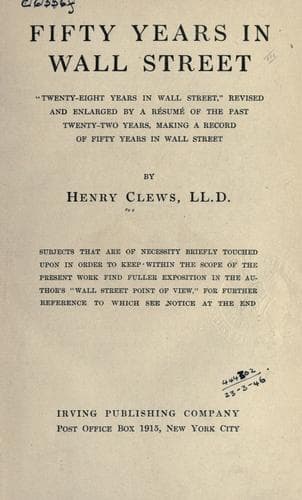
Business; Capitalists and financiers -- United States; Speculation; Wall Street (New York, N.Y.)
THE DEPLETED CONDITION OF THE TREASURY WHEN MR. CHASE TOOK
OFFICE.—PREPARATIONS FOR WAR AND GREAT EXCITEMENT IN
WASHINGTON.—CHIVALROUS SOUTHERNERS IN A FERMENT.—OFFICIALS UP IN
ARMS IN DEFENCE OF THEIR MENACED POSITIONS.—MISCALCULATION WITH
REGARD TO THE PROBABLE DURATION OF THE WAR.—A VISIT TO WASHINGTON
AND AN INTERVIEW WITH SECRETARY CHASE.—DISAPPOINTMENT ABOUT
THE SALE OF GOVERNMENT BONDS.—A PANIC PRECIPITATED IN
WALL STREET.—MILLIONAIRES REDUCED TO INDIGENCE IN A FEW
HOURS.—MIRACULOUSLY SAVED FROM THE WRECK.—HOW IT HAPPENED.
Soon after Mr. Chase came into the Treasury he found that money was
seriously needed. In fact the Treasury was empty. The expenditure for
the fiscal year ending June, 1861, was 62 millions, and there were only
41 millions of revenue to meet them, and even this amount was threatened
with a serious reduction on account of the traitorous and rebellious
attitude of the South.
After President Lincoln had called upon Congress to provide for the
enlistment of 400,000 men, the expenses of the Government were soon
advanced to the enormous amount of a million dollars a day. The
Secretary of the Treasury made a calculation, which he submitted to the
President, showing that the probable expenditures would amount to 318
millions for the ensuing year. He advised that 80 millions be provided
for by taxation, 240 millions by loan, and that 50 millions of Treasury
notes, redeemable in coin on demand, should be issued.
The Secretary was authorized by Congress to borrow a sum not exceeding
250 millions, on the credit of the United States, and as a part of this
loan he was, in the words of the Act, “to issue in exchange for coin, or
pay for salaries or other dues from the United States, not over 50
millions of Treasury notes, bearing no interest, but payable on demand
at New York, Philadelphia or Boston.”
When Mr. Chase advertised for bids on the bonds known as the 81 issue
all bids at 94 and above were accepted, and those under 94 were
rejected.
I got up a syndicate immediately to take the entire balance of the loan
at 94, and went on to Washington to see the Secretary. This syndicate
comprised a number of New York banks and many large capitalists. I
called upon Secretary Chase when I arrived, informed him of the object
of my visit and made him an offer of 94 for the entire balance of the
loan.
He was in favor of the proposition, but requested me to leave the matter
open until the following morning for him to consider. It was a question
with him whether he ought not to give those whose bids had been rejected
an equal opportunity with the parties I represented.
Public-domain text, read in full here on John Shaqi.
Reviews
Reviews
No reviews yet
Be the first to share your thoughts on this work.
Elsewhere in the archive
Join the Discussion
Join the discussion
Sign in to leave a comment or review.
Sign InorCreate an account