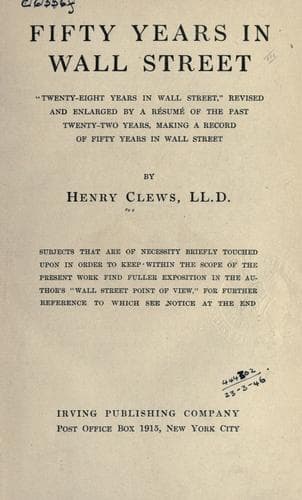
Business; Capitalists and financiers -- United States; Speculation; Wall Street (New York, N.Y.)
The only explanation that seems plausible under these circumstances is,
that the Palmerston-Russell Cabinet interrupted this telegram to Baron
Gros for diplomatic purposes, or that the Baron, seeing that the debate
in Parliament had taken an unfavorable turn, had prudently resolved to
suppress the advice from Napoleon, in order that his master might not
commit himself while England was not heart and soul with him in the
enterprise. In fact, England had begun to see that she had taken a false
position, and Mr. Gladstone’s eloquent spurt, to the effect that
“Jefferson Davis had created a nation,” was no longer the diplomatic
faith of England. She was more influenced by fear than love, as she
always is, and had begun to think, after the capture of New Orleans and
the destruction of the Confederate fleet, that the Federal Government
was capable of organizing a formidable navy. The London _Times_, which
voiced diplomatic sentiment then, said so. During this very debate on
Roebuck’s motion, Lee’s army had been beaten at Gettysburg, Vicksburg
had surrendered and victory was beginning to perch on the Northern
banners everywhere. Napoleon also drew in his horns, complaining
bitterly that “perfidious Albion” had gone back on him, and he was
afraid to permit the war ships, when finished, to leave the French ports
for any destination, and when he permitted the English privateer, the
Rappahannock, to depart, it was under the injunction that the American
minister should know nothing about it.
What Lord Palmerston called a “concatenation of circumstances”
contributed largely to force the Emperor to change his policy towards
the United States. Maximilian’s Mexican expedition was exceedingly
unpopular, trouble was brewing in several parts of the continent, and
Bismarck and Von Moltke were cunningly and deliberately weaving that net
in which the Man of Destiny, seven years later, was hopelessly entangled
at Sedan. His dream of a French American Empire beyond the Mississippi
had vanished long before his last abject act of humiliation in
surrendering the sword of France to Bismarck. And ere he died, a
miserable wreck of disappointed ambition, again a political exile, he
had the opportunity of seeing our own Republic, which he sought to
destroy, rehabilitated, and on its way to become the greatest nation in
history.
[Illustration:
THE HON. JOHN SHERMAN,
Who has taken a prominent part in financial matters since the
beginning of the war, first in making treasury notes a legal tender
in 1862; in proposing the Redemption Act in 1867, which was passed
in 1870, and in the resumption of specie payments in 1879, which was
the crowning success of the financial policy which established the
Government credit on a solid basis.
]
------------------------------------------------------------------------
CHAPTER IX.
SECRETARY CHASE AND THE TREASURY.
Public-domain text, read in full here on John Shaqi.
Reviews
Reviews
No reviews yet
Be the first to share your thoughts on this work.
Elsewhere in the archive
Join the Discussion
Join the discussion
Sign in to leave a comment or review.
Sign InorCreate an account